
Effets de la thérapie répétée par lumière rouge de faible intensité sur la structure et la vascularisation de la choroïde et de la rétine chez l'enfant pré-myope
Titre original : The Effects of Repeated Low-Level Red-Light Therapy on the Structure and Vasculature of the Choroid and Retina in Children with Premyopia
Zhuzhu Liu, Ziwen Sun, Bei Du, Huaixue Gou, Biying Wang, Zeya Lin, Nuo Ren, Emmanuel Eric Pazo, Lin Liu, Ruihua Wei
 Ophthalmology and Therapy, 2024 · article · doi:10.1007/s40123-023-00875-x · cité 63 fois · Accès libre (CC BY-NC)
Rétine et imagerie vasculaireMyopie et erreurs réfractives
En bref
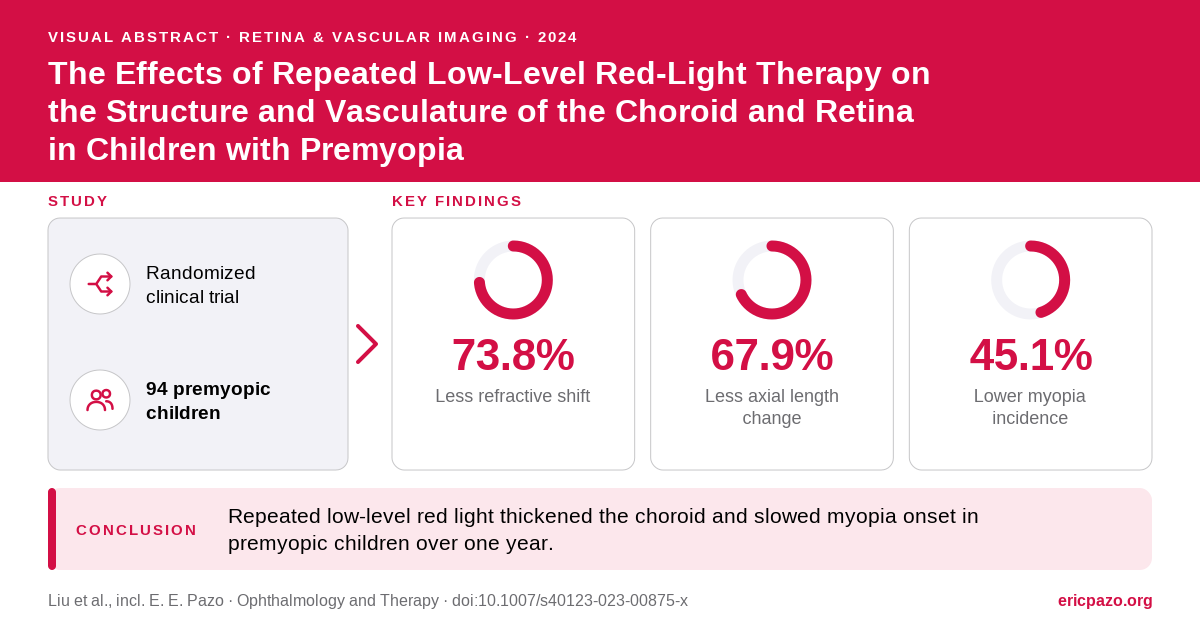
La lumière rouge répétée de faible intensité a épaissi la choroïde et retardé l'apparition de la myopie chez des enfants pré-myopes sur un an.
- Type d'étude
- Essai clinique randomisé
- Échantillon
- 94 enfants pré-myopes
- Moindre glissement réfractif
- 73.8%
- Moindre variation de la longueur axiale
- 67.9%
- Incidence de myopie plus faible
- 45.1%
Résumé
INTRODUCTION : Cette étude avait pour objectif d'explorer les effets de la thérapie répétée par lumière rouge de faible intensité (RLRL) sur la structure et la vascularisation de la choroïde et de la rétine chez des enfants chinois pré-myopes. MÉTHODES : Il s'agissait d'un essai clinique randomisé monocentrique. Au total, 94 enfants pré-myopes (- 0.50 D < équivalent sphérique [ES] ≤ + 0.75 D) ont été répartis au hasard entre le groupe RLRL et le groupe témoin. Des visites de suivi étaient prévues à 1, 3, 6, 9 et 12 mois. La biométrie par cohérence optique a servi à mesurer la longueur axiale (LA) et les paramètres du segment antérieur. L'épaisseur choroïdienne (EC), l'épaisseur rétinienne (ER), la densité vasculaire rétinienne superficielle (SRVD), la densité vasculaire rétinienne profonde (DRVD), la surface de perfusion de la choriocapillaire (CCPA) et le volume vasculaire choroïdien (CVV) ont été mesurés par angiographie en tomographie par cohérence optique, centrée sur les régions fovéolaire, parafovéolaire (ParaF) et périfovéolaire (PeriF). RÉSULTATS : ) (tous P < 0.05). En outre, aucune différence notable n'a été observée entre les groupes pour l'ER fovéolaire et les paramètres vasculaires rétiniens au cours des 12 mois (P > 0.05). Fait notable, la thérapie RLRL a permis de réduire nettement le glissement de l'ES de 73.8 %, de diminuer sensiblement la variation de la LA de 67.9 % et de réduire significativement l'incidence de la myopie de 45.1 % en 1 an. CONCLUSION : Notre étude a montré une augmentation significative de l'EC et du flux dans les yeux traités par RLRL tout au long des 12 mois de l'étude. Associée à la réduction de la progression de l'équivalent sphérique et de l'allongement axial, la RLRL pourrait être utilisée comme traitement efficace pour prévenir la progression chez les pré-myopes. ENREGISTREMENT DE L'ESSAI : ChiCTR2200062028.
Traduit du résumé original en anglais (licence : CC BY-NC).
Afficher le résumé original
INTRODUCTION: The purpose of this study was to explore the effects of repeated low-level red-light (RLRL) therapy on the structure and vasculature of the choroid and retina in Chinese children with premyopia. METHODS: This study was a single-center randomized clinical trial. A total of 94 children with premyopia (- 0.50 D < spherical equivalent [SE] ≤ + 0.75 D) were randomly assigned to either the RLRL therapy or control group. Follow-up visits were planned at 1, 3, 6, 9, and 12 months. Optical coherence biometry was used to measure axial length (AL) and anterior segment parameters. Choroidal thickness (CT), retinal thickness (RT), superficial retinal vascular density (SRVD), deep retinal vascular density (DRVD), choriocapillaris perfusion area (CCPA), and choroidal vessel volume (CVV) were measured by optical coherence tomography angiography, centered on the foveal, parafoveal (ParaF), and perifoveal (PeriF) regions. RESULTS: ) (all P < 0.05). In addition, no notable differences were observed between the groups regarding foveal RT and retinal vascular parameters throughout the 12 months (P > 0.05). Notably, RLRL therapy achieved a notable reduction in SE shift by 73.8%, a substantial decrease in AL change by 67.9%, and a significant reduction in myopia incidence by 45.1% within 1 year. CONCLUSION: Our study demonstrated a significant increase in CT and flow in the RLRL-treated eyes throughout the 12-months of the study. Combined with its reduction in spherical equivalent progression and axial elongation, RLRL could be used as an effective therapy for preventing progression in premyopes. TRIAL REGISTRATION: ChiCTR2200062028.
Mots-clés : low-level red light therapy; low-level laser therapy; myopia progression prevention; choroidal thickness; retinal thickness; retinal vessel density; axial length; spherical equivalent
Accès
Comment citer
Afficher le BibTeX
@article{liu2024the,
  title = {{The Effects of Repeated Low-Level Red-Light Therapy on the Structure and Vasculature of the Choroid and Retina in Children with Premyopia}},
  author = {Liu, Zhuzhu and Sun, Ziwen and Du, Bei and Gou, Huaixue and Wang, Biying and Lin, Zeya and Ren, Nuo and Pazo, Emmanuel Eric and Liu, Lin and Wei, Ruihua},
  journal = {Ophthalmology and Therapy},
  year = {2024},
  doi = {10.1007/s40123-023-00875-x},
  url = {https://doi.org/10.1007/s40123-023-00875-x},
}
Travaux liés
- Mesure automatisée par apprentissage profond du volume de rétinoschisis et de décollement dans la myopie pathologique avec contraction sclérale postérieure (2026)
- Contraction sclérale à deux bandes pour le rétinoschisis maculaire et péripapillaire complexe dans la myopie pathologique (2026)
- Comparaison des mesures de réfraction en âge scolaire avec le réfractomètre portable 2WIN‐S et la skiascopie sous cycloplégie : une étude transversale (2021)
- Association entre la pression de perfusion oculaire moyenne et la rétinopathie diabétique proliférante dans une population du nord de la Chine (2026)
- Association des connaissances et des attitudes vis-à-vis du traitement anti-VEGF avec l'interruption autodéclarée du traitement : une étude de classification à séparation temporelle (2026)