
Absence d'effets indésirables sur la rétine ou le microenvironnement vitréen du lapin après vitréolyse au laser Nd:YAG
Titre original : No side effects on rabbit retina or vitreous microenvironment by nd:YAG laser vitreolysis
Tiezhu Lin, Mingqin Zhang, Bing Heng Wu, Yuanlong An, Emmanuel Eric Pazo, Rong Li, Lijun Shen
 BMC Ophthalmology, 2024 · article · doi:10.1186/s12886-024-03406-9 · cité 2 fois · Accès libre (CC BY)
En bref
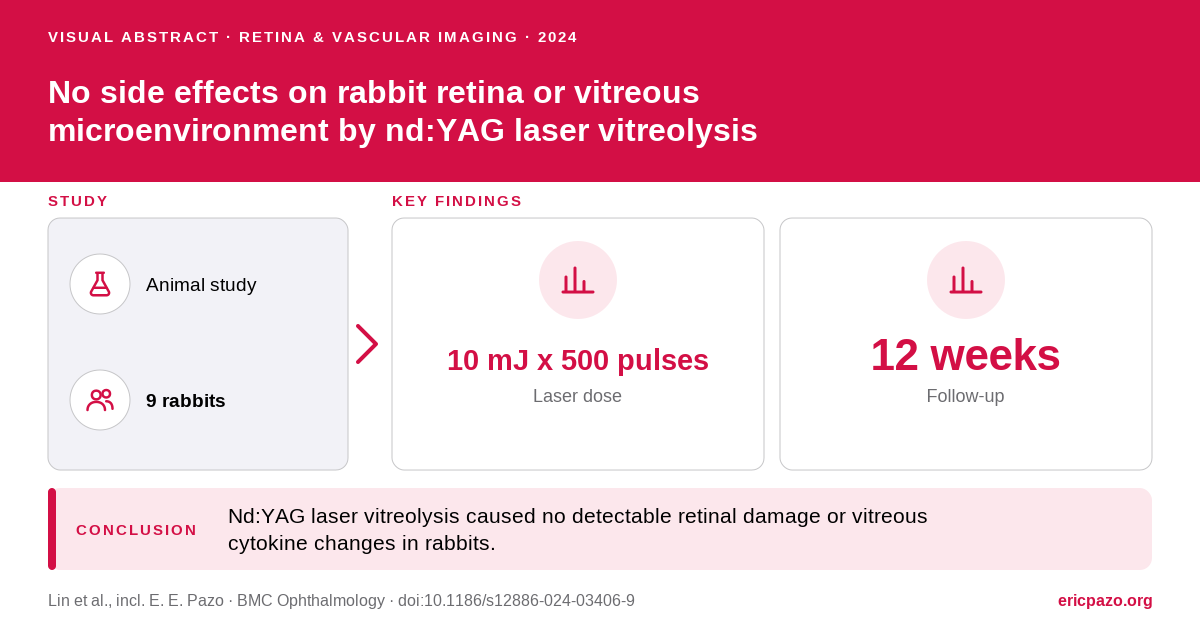
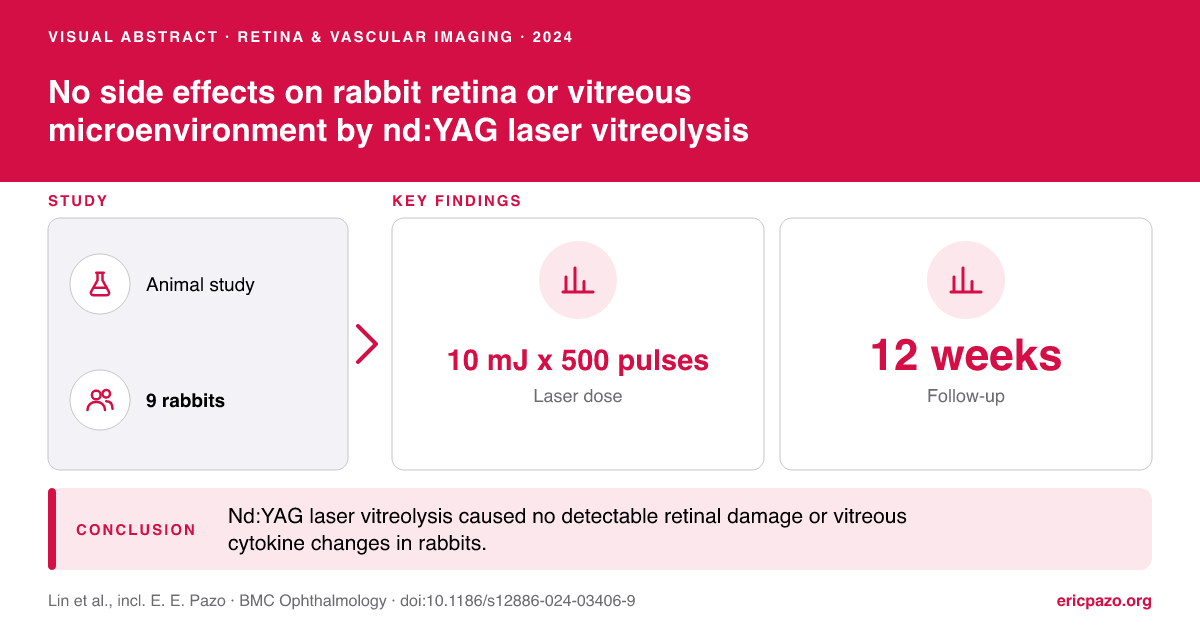
La vitréolyse au laser Nd:YAG n'a causé aucune lésion rétinienne détectable ni modification des cytokines vitréennes chez le lapin.
- Type d'étude
- Étude animale
- Échantillon
- 9 lapins
- Dose laser
- 10 mJ x 500 pulses
- Suivi
- 12 weeks
Résumé
CONTEXTE : Explorer la sécurité de la vitréolyse au laser néodyme:yttrium-aluminium-grenat (Nd:YAG) à partir de l'examen histologique de la rétine et de l'altération des cytokines vitréennes chez le lapin. MÉTHODES : Neuf lapins mâles Néo-Zélandais ont subi une vitréolyse au laser Nd:YAG de 10 mJ x 500 impulsions sur l'œil gauche, l'œil droit servant de témoin. La pression intraoculaire, la rétinophotographie couleur et l'échographie en mode B ont été mesurées avant la vitréolyse au laser Nd:YAG, puis 1 jour, 4 semaines et 12 semaines après. Trois lapins ont été euthanasiés respectivement 1 jour, 4 semaines et 12 semaines après le traitement. La coloration par marquage des extrémités de coupure par dUTP médié par la désoxynucléotidyl transférase terminale (TUNEL) et la coloration à l'hématoxyline-éosine (H&E) ont été utilisées pour rechercher des modifications pathologiques de la rétine. Un dosage immuno-enzymatique (ELISA) a été employé pour détecter l'expression du facteur de croissance de l'endothélium vasculaire (VEGF) et de certaines cytokines inflammatoires, dont la protéine inductible par l'interféron 10 (IP-10), la protéine chimiotactique des monocytes 1 (MCP-1) et l'interleukine 6 (IL-6), dans l'humeur vitrée. L'acide ascorbique (AsA) et le potentiel antioxydant réactif total (TRAP) de l'humeur vitrée ont également été mesurés. RÉSULTATS : Après la vitréolyse au laser Nd:YAG, les taux de VEGF, IP-10, MCP-1, IL6, AsA et TRAP dans l'humeur vitrée n'ont pas changé sensiblement (P > 0.05). Aucune modification pathologique détectable n'a été observée dans les tissus rétiniens, et aucun signal apoptotique n'a été retrouvé. CONCLUSIONS : Le lapin tolère la vitréolyse au laser Nd:YAG sans impact observable sur le tissu rétinien ni sur le microenvironnement du vitré.
Traduit du résumé original en anglais (licence : CC BY).
Afficher le résumé original
BACKGROUND: To explore the safety of Neodymium:Yttrium-aluminum-garnet (Nd:YAG) laser vitreolysis based on the histological examination of the retina and the alteration of vitreous cytokines in the rabbits. METHODS: Nine male New Zealand rabbits underwent Nd:YAG laser vitreolysis of 10 mJ x 500 pulses in the left eyes, while the right eyes were used as controls. Intraocular pressure, color fundus photography, and ultrasound B scan were measured before, as well as 1 day, 4 weeks, and 12 weeks after Nd:YAG laser vitreolysis. Three rabbits were euthanized 1 day, 4 weeks, and 12 weeks after treatment, respectively. Terminal deoxynucleotidyl transferase dUTP nick end labeling (TUNEL) staining and hematoxylin-eosin (H&E) staining were used to look for pathological changes in the retina. An enzyme-linked immunosorbent assay (ELISA) was utilized to detect the expression of vascular endothelial growth factor (VEGF) and some inflammatory cytokines, including interferon inducible protein 10 (IP-10), monocyte chemoattractant protein 1 (MCP-1) and interlenkin 6 (IL-6) in the vitreous humor. The ascorbic acid (AsA) and total reactive antioxidant potential (TRAP) in the vitreous humor were also measured. RESULTS: Following Nd:YAG laser vitreolysis, the levels of VEGF, IP-10, MCP-1, IL6, AsA, and TRAP in the vitreous humor did not change substantially (P > 0.05). There were no detectable pathological changes in the retinal tissues, and no apoptotic signal was found. CONCLUSIONS: Rabbits tolerate Nd:YAG laser vitreolysis without observable impact on retinal tissue or the microenvironment of the vitreous.
Mots-clés : retinal toxicity; vitreous humor; vascular endothelial growth factor; inflammatory cytokines; oxidative stress; vitamin C; apoptosis; rabbit model
Accès
Comment citer
Afficher le BibTeX
@article{lin2024no,
  title = {{No side effects on rabbit retina or vitreous microenvironment by nd:YAG laser vitreolysis}},
  author = {Lin, Tiezhu and Zhang, Mingqin and Wu, Bing Heng and An, Yuanlong and Pazo, Emmanuel Eric and Li, Rong and Shen, Lijun},
  journal = {BMC Ophthalmology},
  year = {2024},
  doi = {10.1186/s12886-024-03406-9},
  url = {https://doi.org/10.1186/s12886-024-03406-9},
}
Travaux liés
- Association entre la pression de perfusion oculaire moyenne et la rétinopathie diabétique proliférante dans une population du nord de la Chine (2026)
- Association des connaissances et des attitudes vis-à-vis du traitement anti-VEGF avec l'interruption autodéclarée du traitement : une étude de classification à séparation temporelle (2026)
- Mesure automatisée par apprentissage profond du volume de rétinoschisis et de décollement dans la myopie pathologique avec contraction sclérale postérieure (2026)
- Développement d'un modèle prédictif fondé sur les cytokines de l'humeur aqueuse pour la réponse au traitement anti-VEGF dans l'œdème maculaire diabétique (2026)
- Répétabilité des mesures des photorécepteurs à cônes avec une ophtalmoscopie laser à balayage en optique adaptative commerciale (Mona II) chez des adultes en bonne santé (2026)