
L'ablation d'iNOS favorise la cicatrisation des plaies cornéennes par activation de la signalisation Akt
Titre original : INOS ablation promotes corneal wound healing via activation of Akt signaling
Ziwen Sun, Kunpeng Lu, Qing He, Yang Tang, Haoru Li, Emmanuel Eric Pazo, Lizhi Hu, Ruihua Wei
 Experimental Eye Research, 2024 · article · doi:10.1016/j.exer.2024.109886 · cité 5 fois
Surface oculaire et sécheresse oculaire
En bref
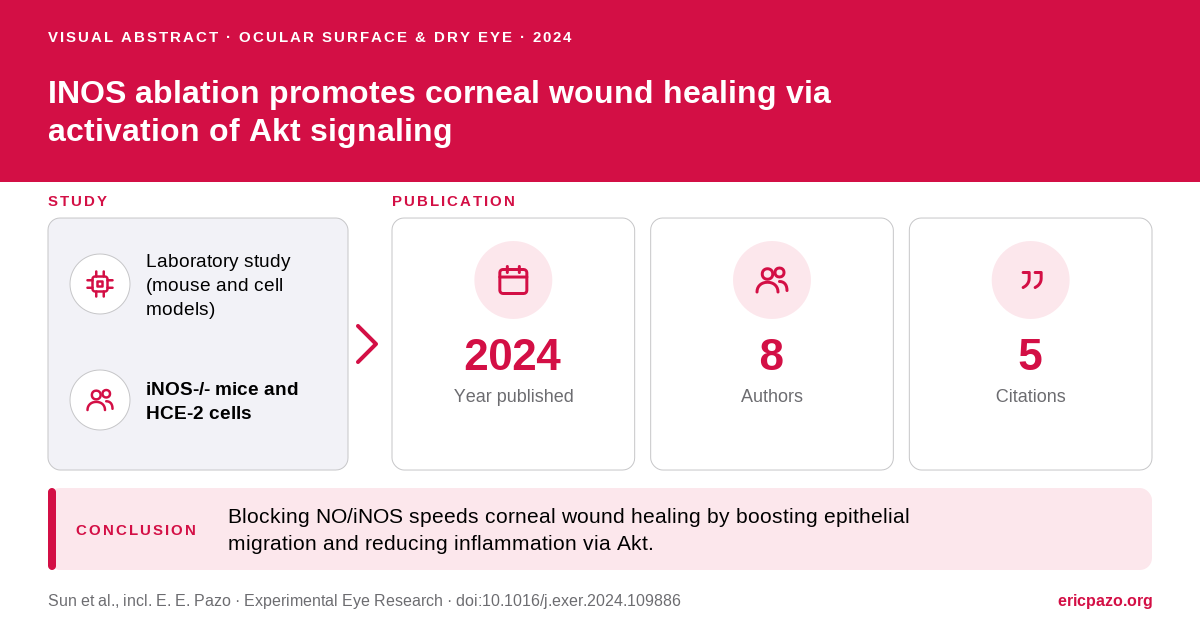
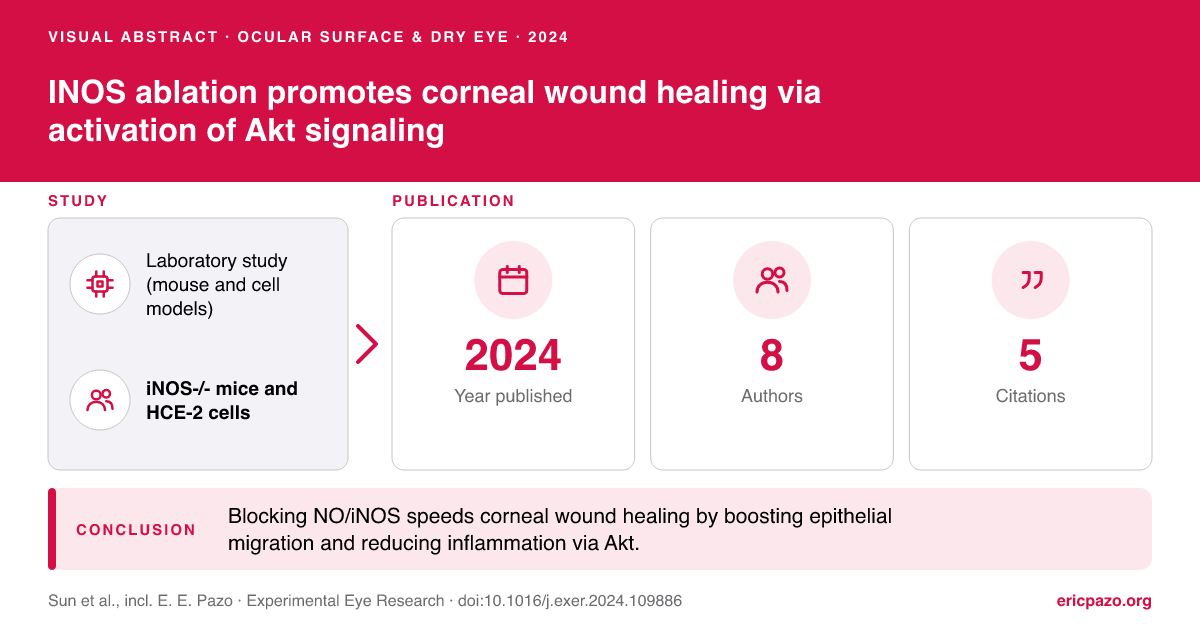
Bloquer NO/iNOS accélère la cicatrisation cornéenne en stimulant la migration épithéliale et en réduisant l'inflammation via Akt.
- Type d'étude
- Étude de laboratoire (modèles murins et cellulaires)
- Échantillon
- Souris iNOS-/- et cellules HCE-2
Résumé
Ce résumé est affiché dans sa langue d'origine, l'anglais, car l'article n'est pas publié sous une licence ouverte autorisant les traductions.
Corneal injury leads to impaired normal structure of the cornea. Improving the wound healing process in epithelial cells significantly contributes to ocular damage treatments. Here, we aimed to investigate the potential mechanisms of nitric oxide (NO) and its mediator, inducible nitric oxide synthase (iNOS), in the process of corneal wound healing. We established a corneal injury model of iNOS -/- mice, and treated human corneal epithelial cell lines (HCE-2) with the iNOS inhibitor L-INL, with or without NO replenishment by supplying sodium nitroferricyanide dihydrate (SNP). Our findings showed that inhibition of NO/iNOS accelerated corneal repair, enhanced uPAR (a receptor protein indicating the migration ability), and improved epithelial cell migration. Furthermore, NO/iNOS ablation activated Akt phosphorylation, reduced neutrophil marker protein MPO expression, and downregulated the transcription of inflammation cytokines CXCL-1, CXCL-2, IL-1β, IL-6, and TNF-α. However, the protective effects of NO/iNOS inhibition are significantly reduced by NO replenishment when treated with SNP. Therefore, we confirmed that inhibiting NO/iNOS improved the corneal wound healing by facilitating epithelial cell migration and reducing inflammatory reactions, which might be related to the activation of the Akt signaling pathway.
Mots-clés : inducible nitric oxide synthase; nitric oxide; corneal wound healing; corneal epithelial cells; Akt signaling; epithelial cell migration; uPAR; neutrophil infiltration
Accès
Comment citer
Afficher le BibTeX
@article{sun2024inos,
  title = {{INOS ablation promotes corneal wound healing via activation of Akt signaling}},
  author = {Sun, Ziwen and Lu, Kunpeng and He, Qing and Tang, Yang and Li, Haoru and Pazo, Emmanuel Eric and Hu, Lizhi and Wei, Ruihua},
  journal = {Experimental Eye Research},
  year = {2024},
  doi = {10.1016/j.exer.2024.109886},
  url = {https://doi.org/10.1016/j.exer.2024.109886},
}
Travaux liés
- Analyse de l'influence de l'espace au bord du volet sur la régénération des nerfs cornéens après LASIK assisté par laser femtoseconde (2026)
- Comparaison des effets de la lumière pulsée intense et de l'hygiène palpébrale sur le film lacrymal et la surface oculaire : une étude contrôlée randomisée (2026)
- Effects of 3% diquafosol sodium on tear film stability, corneal aberration parameters, and vision-related quality of life in pediatric orthokeratology-associated dry eye disease (2026)
- Association entre l'indice de masse corporelle maternel avant la grossesse et l'astigmatisme et la courbure cornéenne de l'enfant : une étude transversale (2025)
- Expression différentielle de la lymphotoxine α, de l'immunoglobuline E et de la métalloprotéinase matricielle 9 lacrymales dans la sécheresse oculaire associée à la conjonctivite allergique (2025)