
Modifications séquentielles immédiates de la couche lipidique du film lacrymal après massage palpébral dans le syndrome de l'œil sec : une étude comparative contrôlée
Titre original : Immediate sequential changes in the tear film lipid layer following eyelid massage in dry eye syndrome: A comparative control study
Jiayan Chen, Sile Yu, Guanghao Qin, Salissou Moutari, Jonathan Edward Moore, Ling Xu, Wei He, Emmanuel Eric Pazo, Xingru He
 Heliyon, 2024 · article · doi:10.1016/j.heliyon.2024.e36590 · cité 4 fois · Accès libre (CC BY-NC-ND)
Surface oculaire et sécheresse oculaire
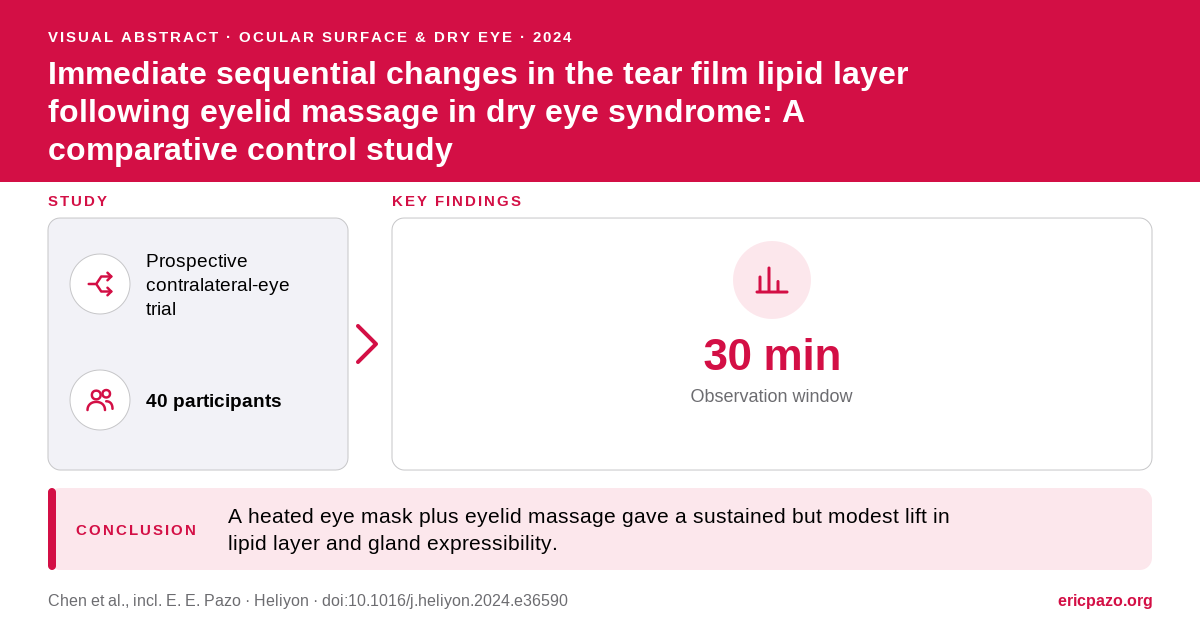
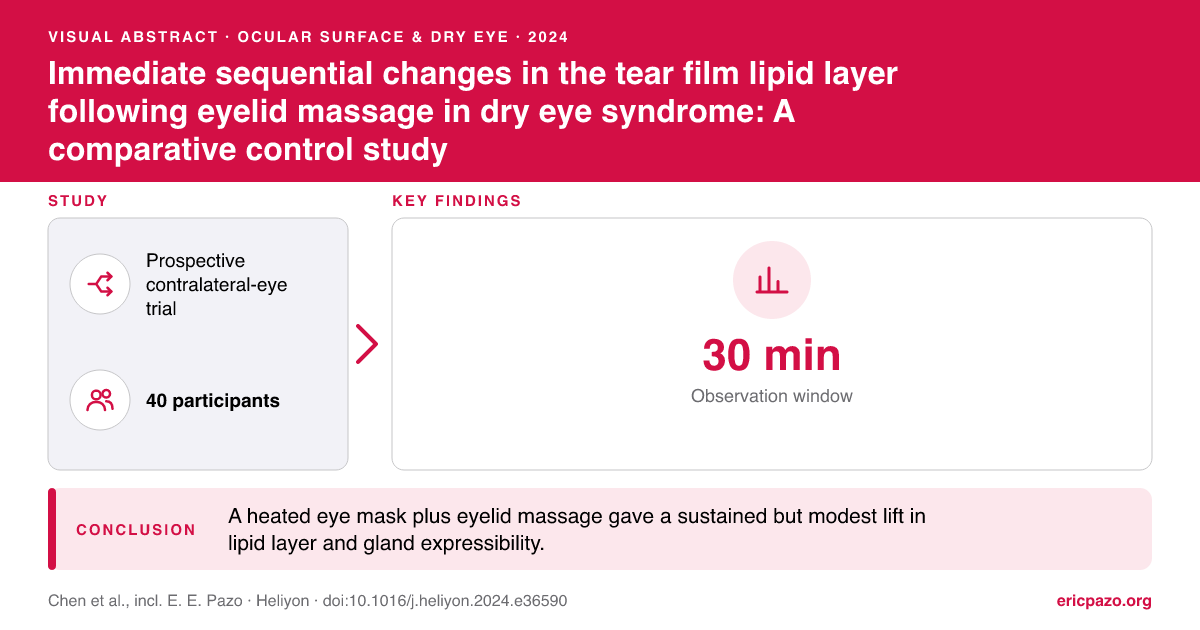
En bref
Un masque oculaire chauffant associé à un massage palpébral a apporté une amélioration durable mais modeste de la couche lipidique et de l'expressibilité glandulaire.
- Type d'étude
- Essai prospectif avec œil controlatéral
- Échantillon
- 40 participants
- Fenêtre d'observation
- 30 min
Résumé
Ce résumé est affiché dans sa langue d'origine, l'anglais, car la licence de l'article (CC BY-NC-ND) ne permet pas de publier des traductions.
Background/Purpose: Meibomian glands are sebaceous glands that release meibum onto the ocular surface; enhancing the quality and quantity of meibum secretions has been proven to improve signs and symptoms of evaporative dry eye (EDE) and meibomian gland dysfunction (MGD). This study aimed to evaluate and compare the efficacy of a heated eye mask (HEM) and eyelid massage device EyePeace (EP) in alleviating signs and symptoms of evaporative dry eye. Methods: Forty dry eye participants were recruited in a prospective, contralateral-eye trial study. After undergoing 10 min of HEM therapy, eyelid massage therapy was applied to one eye by the device. The efficiency was assessed at four time points: baseline (0 min), 5 min (5 min), 15 min (15 min), and 30 min (30 min). Non-invasive breakup time (NITBUT), redness score (RS Score), tear meniscus height (TMH), tear-film lipid layer (TFLL), endothelial cell count (ECC), meibomian gland expressibility (MGEx), meibomian gland quality (MGQ), conjunctivocorneal staining (CS), ocular surface temperature (OST), best corrected visual acuity (BCVA), intraocular pressure (IOP), central corneal thickness (CCT) flat-axis keratometry value (K1), and steep-axis keratometry value (K2), were examined. Results: > 0.05) at all test time points. Conclusion: The application of a heated eye mask followed by a gentle massage using EyePeace on the eyelids can have a sustained improvement in the tear film lipid layer and meibomian gland expressivity score but not clinically significant, and does not pose any significant immediate impact on the cornea.Trial registration number: NCT06158997.
Mots-clés : evaporative dry eye; meibomian gland dysfunction; eyelid massage; tear film lipid layer; meibum; meibomian gland expressibility; ocular surface temperature; corneal endothelial cell count
Accès
Comment citer
Afficher le BibTeX
@article{chen2024immediate,
  title = {{Immediate sequential changes in the tear film lipid layer following eyelid massage in dry eye syndrome: A comparative control study}},
  author = {Chen, Jiayan and Yu, Sile and Qin, Guanghao and Moutari, Salissou and Moore, Jonathan Edward and Xu, Ling and He, Wei and Pazo, Emmanuel Eric and He, Xingru},
  journal = {Heliyon},
  year = {2024},
  doi = {10.1016/j.heliyon.2024.e36590},
  url = {https://doi.org/10.1016/j.heliyon.2024.e36590},
}
Travaux liés
- Analyse de l'influence de l'espace au bord du volet sur la régénération des nerfs cornéens après LASIK assisté par laser femtoseconde (2026)
- Comparaison des effets de la lumière pulsée intense et de l'hygiène palpébrale sur le film lacrymal et la surface oculaire : une étude contrôlée randomisée (2026)
- Effects of 3% diquafosol sodium on tear film stability, corneal aberration parameters, and vision-related quality of life in pediatric orthokeratology-associated dry eye disease (2026)
- Association entre l'indice de masse corporelle maternel avant la grossesse et l'astigmatisme et la courbure cornéenne de l'enfant : une étude transversale (2025)
- Expression différentielle de la lymphotoxine α, de l'immunoglobuline E et de la métalloprotéinase matricielle 9 lacrymales dans la sécheresse oculaire associée à la conjonctivite allergique (2025)