
Comparaison des effets thérapeutiques de la ciclosporine A à 0.05 % et de la fluorométholone à 0.1 % chez des patients chinois atteints de sécheresse oculaire légère ne répondant pas aux larmes artificielles : une étude contrôlée randomisée
Titre original : Comparison of therapeutic effects of 0.05% Cyclosporine A versus 0.1% Fluorometholone in Chinese patients with mild dry eye unresponsive to artificial tears: a randomized control study
Huijuan Gao, Lu Zhao, Aoxue Du, Xia Zhang, Mengdi Chai, Lin Liu, Emmanuel Eric Pazo, Ruihua Wei
 BMC Ophthalmology, 2024 · article · doi:10.1186/s12886-024-03771-5 · cité 8 fois · Accès libre (CC BY-NC-ND)
Surface oculaire et sécheresse oculaire
En bref
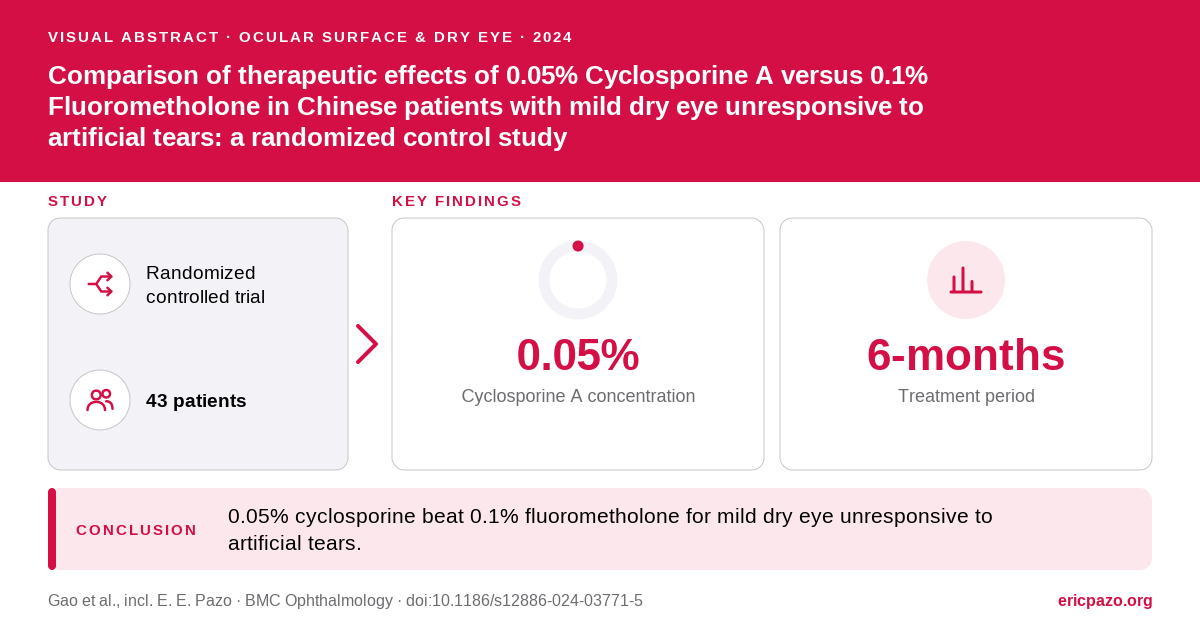
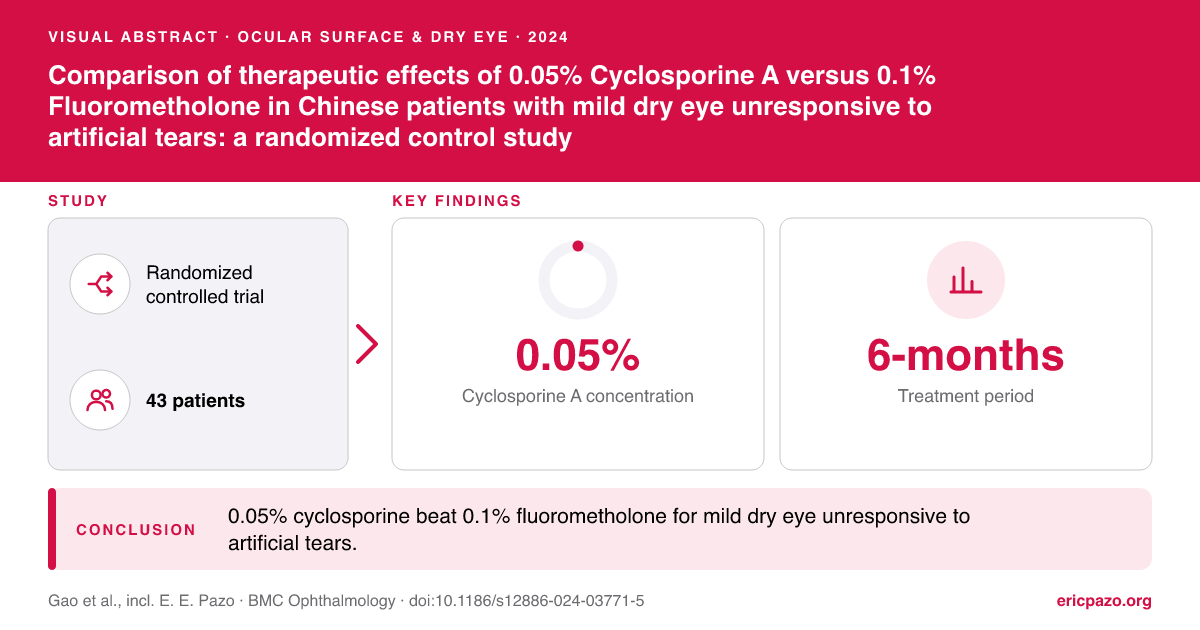
La ciclosporine à 0.05 % a surpassé la fluorométholone à 0.1 % dans la sécheresse oculaire légère ne répondant pas aux larmes artificielles.
- Type d'étude
- Essai contrôlé randomisé
- Échantillon
- 43 patients
- Concentration de ciclosporine A
- 0.05%
- Durée du traitement
- 6-months
Résumé
Ce résumé est affiché dans sa langue d'origine, l'anglais, car la licence de l'article (CC BY-NC-ND) ne permet pas de publier des traductions.
BACKGROUND: To assess and compare the therapeutic outcomes of 0.05% Cyclosporine A (CsA) ophthalmic solution versus 0.1% Fluorometholone (FML) eyedrops in Chinese patients with mild dry eye disease (DED) unresponsive to conventional artificial tears (AT). METHODS: A total of 43 patients with mild DED, who have failed to respond to conventional AT therapy for over 3 months, were randomly assigned to receive either 0.05% CsA or 0.1% FML twice daily for 6-months. In addition, all the patients were instructed to use 0.1% SH 4 times a day as supplementary therapy. Dry eye examination, including Ocular Surface Disease Index (OSDI) questionnaire, non-invasive tear break-up time (NIBUT), Schirmer scores, corneal fluorescein staining (CFS) scores, and conjunctival goblet cell (CGC) density, intraocular pressure (IOP), Best corrected visual acuity (BCVA) was conducted at baseline and then evaluated at 1, 3, and 6 months after treatment. Corneal endothelial cell density, corneal dendritic cells (DCs) and nerves were assessed by in vivo confocal microscopy at baseline and 6 months after treatment. RESULTS: At 3 and 6 months after treatment, OSDI scores in the 0.05% CsA group showed more improvement than those in the 0.1% FML group. CFS was significantly lower and Schirmer scores were significantly higher in 0.05% CsA group compared with 0.1% FML group. NIBUT improved significantly in both groups, with greater improvement in the 0.05% CsA group at the 1-, 3-, and 6-month visits. Throughout the duration of the study, the 0.1% FML group exhibited no notable enhancement in CGC density. Conversely, a substantial elevation in CGC density was observed in the 0.05% CsA group. After 6 months of treatment, significantly reduced corneal DC density and area were obtained in 0.05% CsA group as compared to 0.1% FML group, while there were no significant changes in cornea nerve fiber density, cornea nerve fiber length and cornea nerve fiber width in both groups. Additionally, after 6 months of treatment, neither group showed any statistically significant changes in IOP, BCVA or in corneal endothelial cell density. CONCLUSION: The administration of 0.05% CsA proved effective in managing mild DED, offering a supplementary advantage in improving Schirmer scores, restoring CGC density and reducing corneal DC density compared to 0.1% FML eyedrops. Consequently, 0.05% CsA eyedrops are recommended as a safe and efficacious therapeutic alternative for patients with mild DED who fail to respond to conventional tear substitutes therapy. CLINICAL TRIAL REGISTRATION NUMBER: Chinese Clinical Trial Registry, ChiCTR2200066441, Registered 06 December 2022-Retrospectively registered.
Mots-clés : cyclosporine; fluorometholone; dry eye; artificial tears; corticosteroid therapy; ocular surface disease; conjunctival goblet cells; corneal dendritic cells
Accès
Comment citer
Afficher le BibTeX
@article{gao2024comparison,
  title = {{Comparison of therapeutic effects of 0.05% Cyclosporine A versus 0.1% Fluorometholone in Chinese patients with mild dry eye unresponsive to artificial tears: a randomized control study}},
  author = {Gao, Huijuan and Zhao, Lu and Du, Aoxue and Zhang, Xia and Chai, Mengdi and Liu, Lin and Pazo, Emmanuel Eric and Wei, Ruihua},
  journal = {BMC Ophthalmology},
  year = {2024},
  doi = {10.1186/s12886-024-03771-5},
  url = {https://doi.org/10.1186/s12886-024-03771-5},
}
Travaux liés
- Analyse de l'influence de l'espace au bord du volet sur la régénération des nerfs cornéens après LASIK assisté par laser femtoseconde (2026)
- Comparaison des effets de la lumière pulsée intense et de l'hygiène palpébrale sur le film lacrymal et la surface oculaire : une étude contrôlée randomisée (2026)
- Effects of 3% diquafosol sodium on tear film stability, corneal aberration parameters, and vision-related quality of life in pediatric orthokeratology-associated dry eye disease (2026)
- Association entre l'indice de masse corporelle maternel avant la grossesse et l'astigmatisme et la courbure cornéenne de l'enfant : une étude transversale (2025)
- Expression différentielle de la lymphotoxine α, de l'immunoglobuline E et de la métalloprotéinase matricielle 9 lacrymales dans la sécheresse oculaire associée à la conjonctivite allergique (2025)