
Caractéristiques cliniques de la surface oculaire et expression de MUC5AC chez les diabétiques : une étude en population
Titre original : Clinical ocular surface characteristics and expression of MUC5AC in diabetics: a population-based study
Zijie Fang, Ke Liu, Emmanuel Eric Pazo, Fei Ran Li, Lianqing Chang, Zhongfang Zhang, Caijie Zhang, Yue Huang, Ruibo Yang, Hui Liu, Chen Zhang, Shaozhen Zhao
 Eye, 2024 · article · doi:10.1038/s41433-024-03252-5 · cité 13 fois
Surface oculaire et sécheresse oculaire
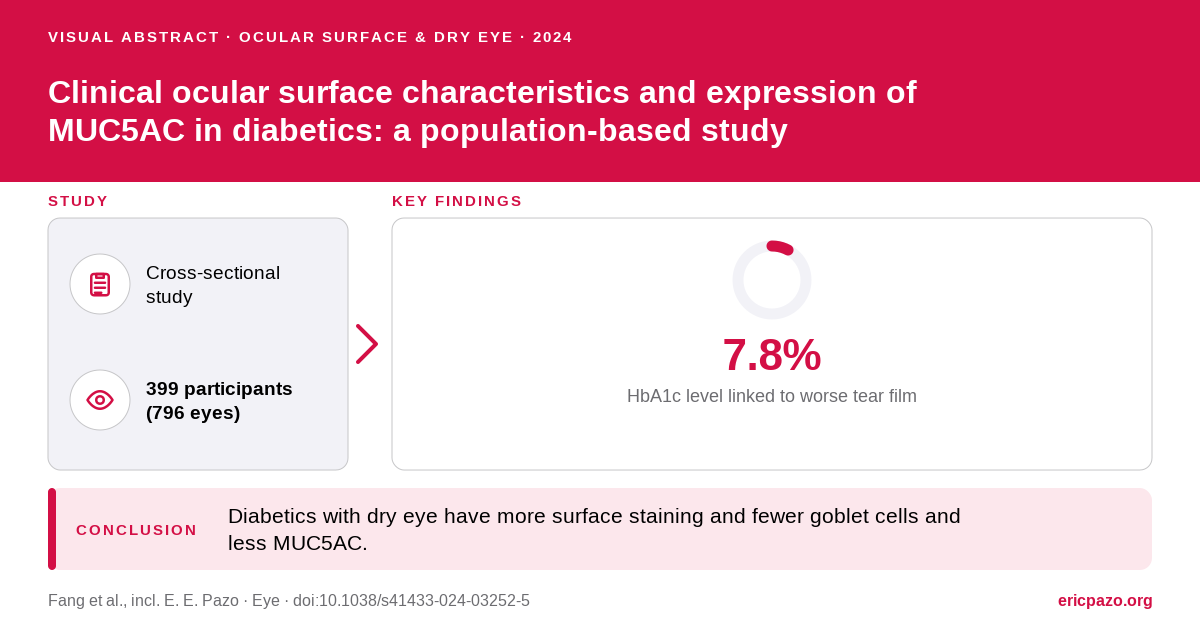
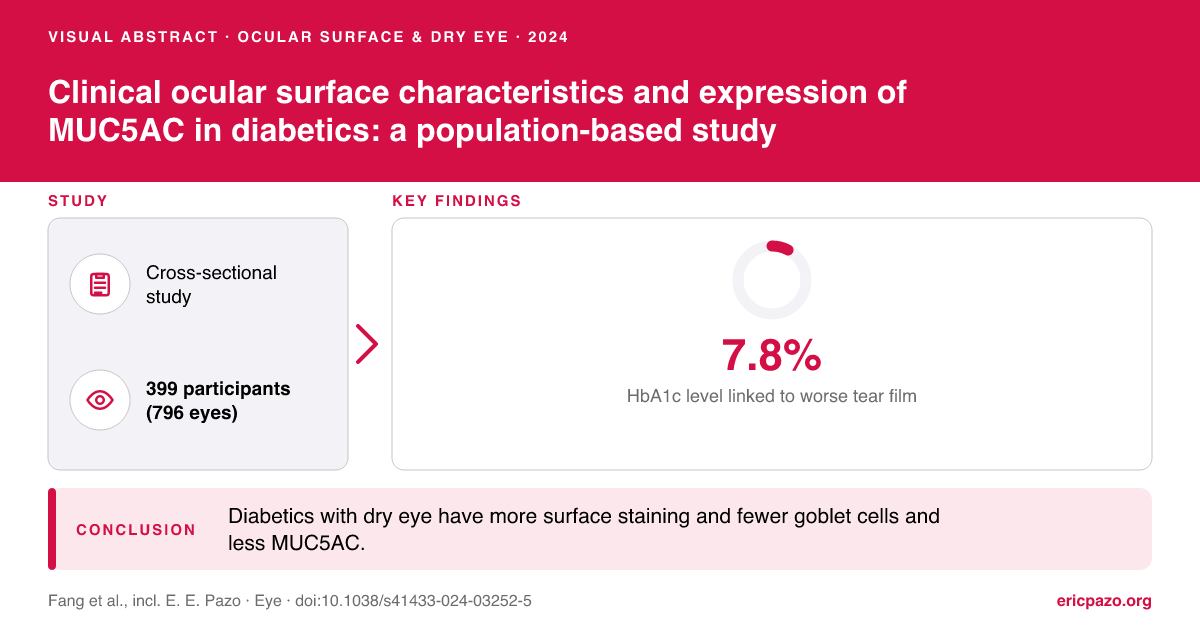
En bref
Les diabétiques atteints de sécheresse oculaire présentent davantage de coloration de surface, moins de cellules caliciformes et moins de MUC5AC.
- Type d'étude
- Étude transversale
- Échantillon
- 399 participants (796 yeux)
- Taux d'HbA1c lié à un film lacrymal dégradé
- 7.8%
Résumé
Ce résumé est affiché dans sa langue d'origine, l'anglais, car l'article n'est pas publié sous une licence ouverte autorisant les traductions.
Objectives To investigate the clinical characteristics and the expression of mucin 5AC (MUC5AC) in in diabetic and non-diabetic subjects with or without dry eye disease. Methods A total of 399 participants (796 eyes) aged 50-80 years were enrolled in this study. Participants were divided into 4 groups: non-diabetic without dry eye group (normal group), non-diabetic with dry eye group, diabetic without dry eye group and diabetic with dry eye group. Demographic information, fasting plasma glucose (FBG), and glycated haemoglobin A1C (HbA1C) data were collected. Additionally, ocular surface disease index (OSDI) questionnaire, signs of dry eye, tear osmolarity, and meibomian glands were evaluated. Tear MUC5AC expression and conjunctival goblet cells density (GCD) were tested. Results Compared with non-diabetic with dry eye group, diabetic with dry eye group showed significantly lower tear film osmolarity (TFO), but higher corneal fluorescein and conjunctival lissamine green staining scores. In comparison with diabetic without dry eye group, diabetic with dry eye group showed significantly higher TFO, corneal fluorescein and conjunctival lissamine green staining scorers. The MUC5AC concentration and GCD of diabetic with dry eye group was significantly lower than those of the non-diabetic with dry eye group. Diabetic subjects with higher HbA1c levels (≥7.8%) showed higher TFO and shorter fluorescein tear break time. Conclusion Diabetics with dry eye exhibited notably higher corneal fluorescein and conjunctival lissamine green staining scores. Conjunctival goblet cells and MUC5AC were significantly reduced in diabetics. Higher TFO was associated with the duration of diabetes and HbA1c levels.
Mots-clés : MUC5AC; mucin; ocular surface disease; conjunctival goblet cells; tear osmolarity; HbA1c; fluorescein staining; lissamine green staining
Accès
Comment citer
Afficher le BibTeX
@article{fang2024clinical,
  title = {{Clinical ocular surface characteristics and expression of MUC5AC in diabetics: a population-based study}},
  author = {Fang, Zijie and Liu, Ke and Pazo, Emmanuel Eric and Li, Fei Ran and Chang, Lianqing and Zhang, Zhongfang and Zhang, Caijie and Huang, Yue and Yang, Ruibo and Liu, Hui and Zhang, Chen and Zhao, Shaozhen},
  journal = {Eye},
  year = {2024},
  doi = {10.1038/s41433-024-03252-5},
  url = {https://doi.org/10.1038/s41433-024-03252-5},
}
Travaux liés
- Analyse de l'influence de l'espace au bord du volet sur la régénération des nerfs cornéens après LASIK assisté par laser femtoseconde (2026)
- Comparaison des effets de la lumière pulsée intense et de l'hygiène palpébrale sur le film lacrymal et la surface oculaire : une étude contrôlée randomisée (2026)
- Effects of 3% diquafosol sodium on tear film stability, corneal aberration parameters, and vision-related quality of life in pediatric orthokeratology-associated dry eye disease (2026)
- Association entre l'indice de masse corporelle maternel avant la grossesse et l'astigmatisme et la courbure cornéenne de l'enfant : une étude transversale (2025)
- Expression différentielle de la lymphotoxine α, de l'immunoglobuline E et de la métalloprotéinase matricielle 9 lacrymales dans la sécheresse oculaire associée à la conjonctivite allergique (2025)