
Protocole d'un essai prospectif en groupes parallèles, randomisé et comparatif évaluant la sécurité et l'efficacité de la lumière pulsée intense (LPI) associée au collyre de diquafosol (DQS) à 3 % dans le syndrome de l'œil sec
Titre original : Protocol for a parallel assignment prospective, randomised, comparative trial to evaluate the safety and efficacy of intense pulsed light (IPL) combined with 3% diquafosol (DQS) ophthalmic solution in dry eye syndrome
Jiayan Chen, Guanghao Qin, Liangzhe Li, Yifan Qi, Huixin Che, He Huang, Yang Xia, Qing Zhang, Yi Wu, Lanting Yang, Salissou Moutari, Jonathan Edward Moore, Ling Xu, Wei He, Sile Yu, Emmanuel Eric Pazo, Xingru He
 BMJ Open, 2023 · article · doi:10.1136/bmjopen-2023-073055 · cité 4 fois · Accès libre (CC BY-NC)
Surface oculaire et sécheresse oculaire
En bref
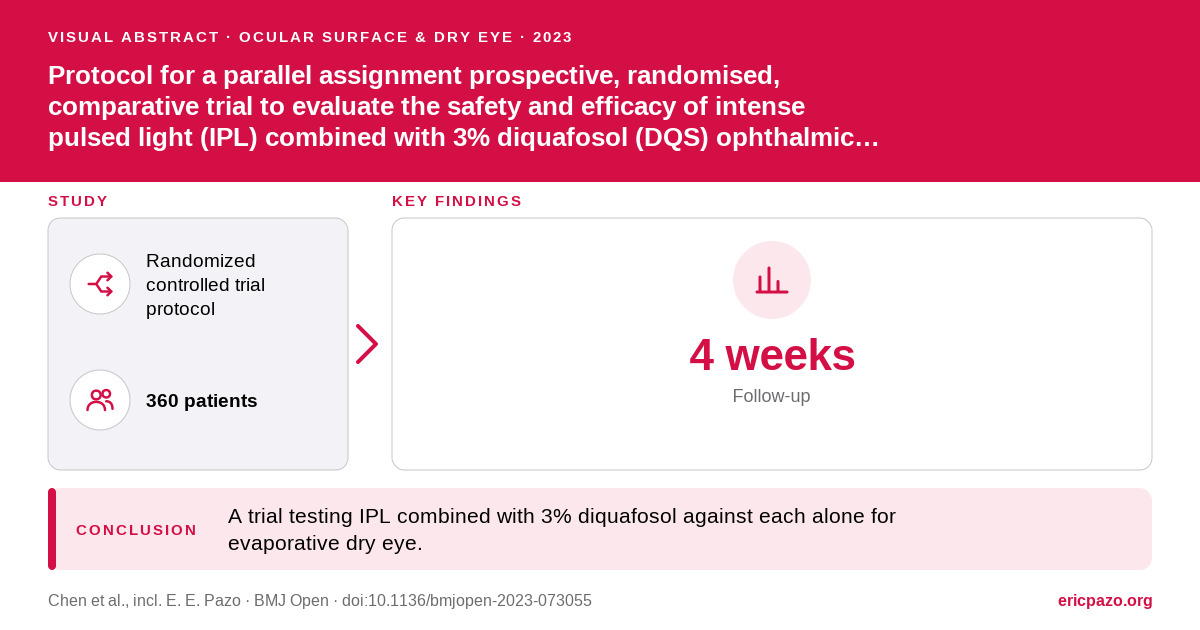
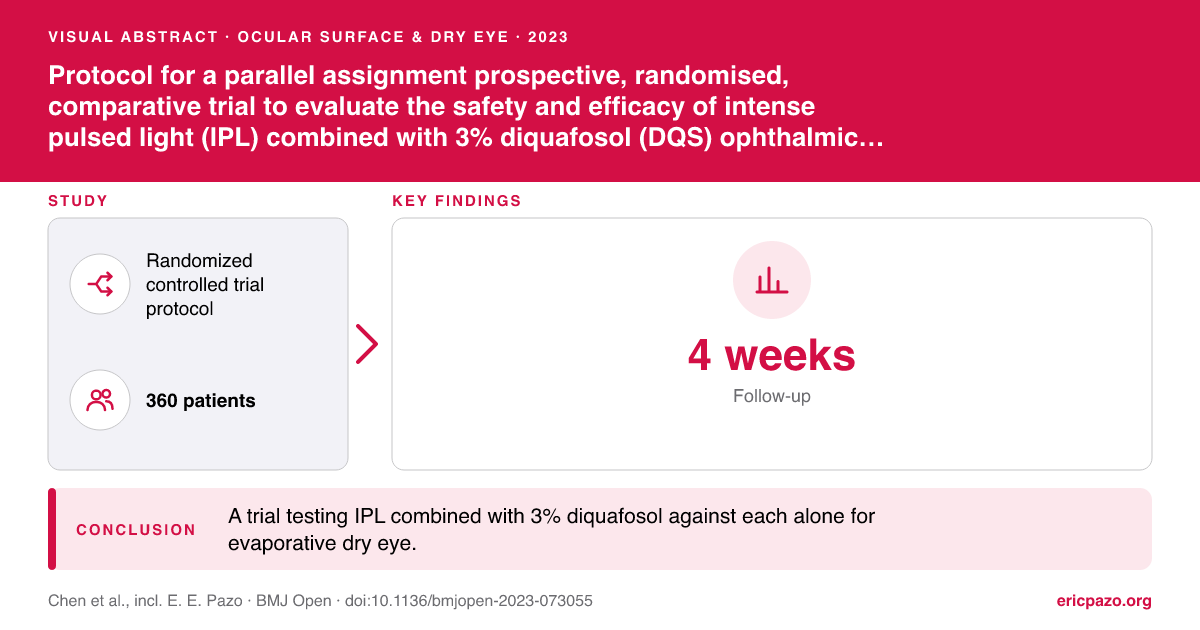
Un essai comparant la LPI associée au diquafosol à 3 % à chacun de ces traitements seul dans la sécheresse oculaire évaporative.
- Type d'étude
- Protocole d'essai contrôlé randomisé
- Échantillon
- 360 patients
- Suivi
- 4 weeks
Résumé
INTRODUCTION : La sécheresse oculaire évaporative (SOE) est fréquente et peut entraîner une douleur oculaire, une baisse de la qualité visuelle et une altération de la qualité de vie. La lumière pulsée intense (LPI) et le collyre de diquafosol à 3 % se sont révélés bénéfiques pour réduire les signes et symptômes de la sécheresse oculaire. MÉTHODES ET ANALYSE : Un essai clinique randomisé sera mené au He Eye Specialist Hospital de Shenyang. 360 patients atteints de sécheresse oculaire seront répartis au hasard et à parts égales entre le groupe LPI, le groupe DQS (collyre de diquafosol à 3 %) et le groupe LPI+ (LPI associée au collyre de diquafosol à 3 %). Tous les groupes seront suivis pendant 4 semaines. Les critères de jugement principaux seront la variation, par rapport à l'inclusion, du temps de rupture lacrymale non invasif et de l'Ocular Surface Disease Index. Les critères secondaires comprendront les variations de la coloration conjonctivale et cornéenne à la fluorescéine et au vert de lissamine, de la fonction des glandes de Meibomius et de la qualité de leur sécrétion, du score de la couche lipidique du film lacrymal, de la hauteur du ménisque lacrymal et de l'hyperhémie conjonctivale (score de rougeur). Les événements indésirables seront également surveillés et consignés. DISCUSSION : Cette étude vise à déterminer si l'association de la LPI au collyre de diquafosol à 3 % (groupe d'étude), LPI+ (groupe d'étude), est plus efficace que la LPI (groupe témoin actif) ou le DQS (groupe témoin actif) chez les participants atteints de SOE. ÉTHIQUE ET DIFFUSION : Prise en charge de la sécheresse oculaire par LPI associée au collyre de diquafosol à 3 %, enregistrée le 23 janvier 2023. Numéro d'approbation éthique : IRB (2022) K029.01. Les résultats de l'étude seront partagés quel que soit le sens de l'effet. NUMÉRO D'ENREGISTREMENT DE L'ESSAI : NCT05694026.
Traduit du résumé original en anglais (licence : CC BY-NC).
Afficher le résumé original
INTRODUCTION: Evaporative dry eye (EDE) is common and can lead to ocular pain, decreased visual quality and reduced quality of life. Intense pulsed light (IPL) and 3% diquafosol ophthalmic solution have been found to be beneficial in reducing signs and symptoms of dry eye. METHODS AND ANALYSIS: A randomised clinical trial will be performed at He Eye Specialist Hospital in Shenyang. 360 dry eye disease patients will be equally divided randomly into the IPL group, DQS group (3% diquafosol ophthalmic solution eye-drops) and IPL+group (IPL combined with 3% diquafosol eye-drops). All groups will be followed up for 4 weeks. The primary outcome measures will be the non-invasive tear break-up time and the Ocular Surface Disease Index change from the baseline. The secondary outcome measures willincludeconjunctival and cornea staining with fluorescein and lissamine, meibomian gland function and secretion quality, tear film lipid layer score, tear meniscus height, conjunctival hyperemia (redness score) changes . Adverse events also will be monitored and documented. DISCUSSION: This study aimed to assess whether the combination of IPL with 3% diquafosol ophthalmic solution (study group), IPL+ (study group), is more effective than IPL (active control group) or DQS (active control group) in participants with EDE. ETHICS AND DISSEMINATION: Management of dry eye with IPL combined with 3% diquafosol ophthalmic solution, registered on 23 January 2023. Ethics approval number: IRB (2022) K029.01. The study's findings will be shared regardless of the effect's direction. TRIAL REGISTRATION NUMBER: NCT05694026.
Mots-clés : dry eye; evaporative dry eye; intense pulsed light; diquafosol; eye drops; combination therapy; tear film break-up time; Ocular Surface Disease Index
Accès
Comment citer
Afficher le BibTeX
@article{chen2023protocol,
  title = {{Protocol for a parallel assignment prospective, randomised, comparative trial to evaluate the safety and efficacy of intense pulsed light (IPL) combined with 3% diquafosol (DQS) ophthalmic solution in dry eye syndrome}},
  author = {Chen, Jiayan and Qin, Guanghao and Li, Liangzhe and Qi, Yifan and Che, Huixin and Huang, He and Xia, Yang and Zhang, Qing and Wu, Yi and Yang, Lanting and Moutari, Salissou and Moore, Jonathan Edward and Xu, Ling and He, Wei and Yu, Sile and Pazo, Emmanuel Eric and He, Xingru},
  journal = {BMJ Open},
  year = {2023},
  doi = {10.1136/bmjopen-2023-073055},
  url = {https://doi.org/10.1136/bmjopen-2023-073055},
}
Travaux liés
- Analyse de l'influence de l'espace au bord du volet sur la régénération des nerfs cornéens après LASIK assisté par laser femtoseconde (2026)
- Comparaison des effets de la lumière pulsée intense et de l'hygiène palpébrale sur le film lacrymal et la surface oculaire : une étude contrôlée randomisée (2026)
- Effects of 3% diquafosol sodium on tear film stability, corneal aberration parameters, and vision-related quality of life in pediatric orthokeratology-associated dry eye disease (2026)
- Association entre l'indice de masse corporelle maternel avant la grossesse et l'astigmatisme et la courbure cornéenne de l'enfant : une étude transversale (2025)
- Expression différentielle de la lymphotoxine α, de l'immunoglobuline E et de la métalloprotéinase matricielle 9 lacrymales dans la sécheresse oculaire associée à la conjonctivite allergique (2025)