
Protocole d'un essai monocentrique, randomisé et contrôlé comparant l'efficacité clinique du diquafosol à 3 % et de l'acide hyaluronique à 0.1 % chez des patients diabétiques atteints de sécheresse oculaire
Titre original : A protocol for a single center, randomized, controlled trial comparing the clinical efficacy of 3% diquafosol and 0.1% hyaluronic acid in diabetic patients with dry eye disease
Jiayan Chen, Yimeng Chen, Guanghao Qin, Liangzhe Li, Mingze Li, Yuan Cheng, Shuting Zhuang, Zhihui Li, Qing Zhang, Yi Wu, Lanting Yang, Salissou Moutari, Jonathan Edward Moore, Ling Xu, Wei He, Sile Yu, Emmanuel Eric Pazo, Xingru He
 Trials, 2023 · article · doi:10.1186/s13063-023-07818-8 · cité 2 fois · Accès libre (CC BY)
Surface oculaire et sécheresse oculaire
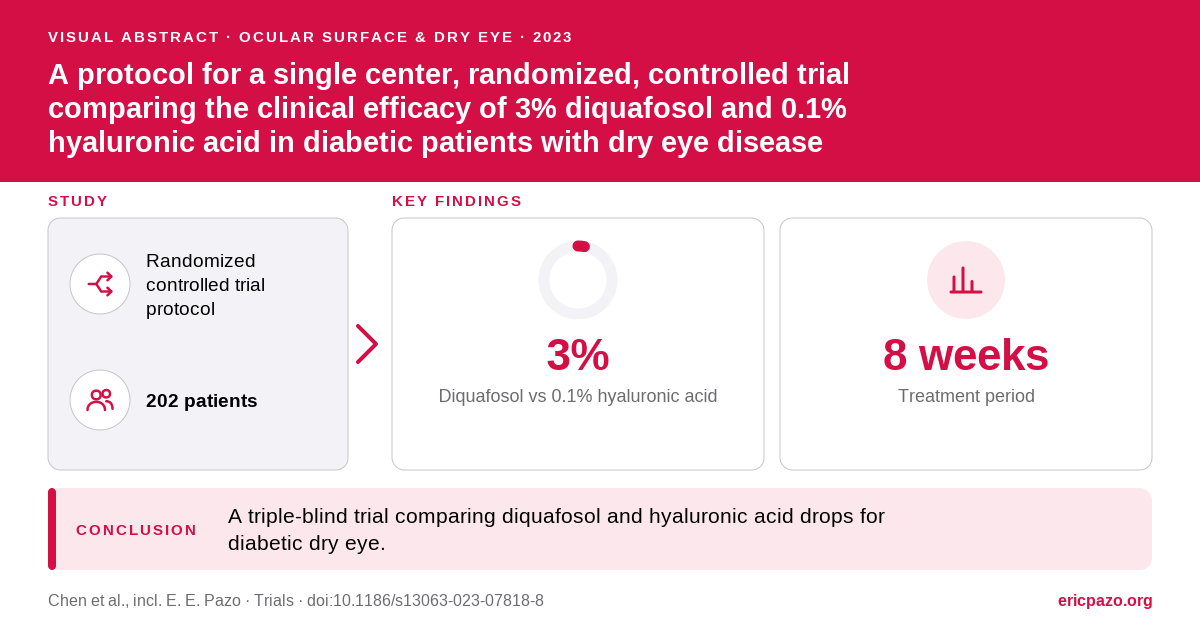
En bref
Un essai en triple aveugle comparant les collyres de diquafosol et d'acide hyaluronique dans la sécheresse oculaire du diabétique.
- Type d'étude
- Protocole d'essai contrôlé randomisé
- Échantillon
- 202 patients
- Diquafosol contre acide hyaluronique à 0.1 %
- 3%
- Durée du traitement
- 8 weeks
Résumé
CONTEXTE : La prévalence mondiale du diabète (DM) continue d'augmenter, et 70 % des diabétiques présentent une sécheresse oculaire (SO) entraînant des anomalies secondaires de l'épithélium cornéen, des nerfs cornéens, du film lacrymal ou de l'endothélium cornéen. En outre, les personnes diabétiques sécrètent moins de larmes que les personnes en bonne santé. Bien que plusieurs traitements anti-inflammatoires de la sécheresse oculaire soient actuellement administrés aux diabétiques, leur efficacité n'a pas été étudiée en détail. Cette étude visait donc à comparer l'efficacité des collyres de diquafosol (DQS) à 3 % et d'acide hyaluronique (HA) à 0.1 % chez des patients diabétiques atteints de sécheresse oculaire. MÉTHODES : Cet essai contrôlé randomisé en triple aveugle inclura 202 patients atteints de SO liée au diabète, répartis entre DQS (n = 101) et HA (n = 101), une goutte six fois par jour pendant 8 semaines. La couche lipidique du film lacrymal, le temps de rupture non invasif, le score de coloration cornéo-conjonctivale, la sensibilité cornéenne, le taux lacrymal de MMP-9, l'expression et la qualité des glandes de Meibomius, la hauteur du ménisque lacrymal, les nerfs cornéens, les variations des cellules immunitaires/inflammatoires, l'hyperhémie conjonctivale et le score du questionnaire d'indice de la maladie de la surface oculaire seront évalués et comparés à l'inclusion, à la semaine 4 et à la semaine 8. DISCUSSION : Cette étude sera un essai clinique standardisé et scientifique conçu pour évaluer les effets thérapeutiques et la sécurité du DQS et du HA dans le traitement de la sécheresse oculaire du diabétique. ENREGISTREMENT DE L'ESSAI : ClinicalTrials.govNCT05682547. Enregistré le 05 décembre 2022.
Traduit du résumé original en anglais (licence : CC BY).
Afficher le résumé original
Abstract Background The global prevalence of diabetes mellitus (DM) continues to rise and 70% of diabetic individuals have dry eye disease (DED) that leads to subsequent abnormalities of the corneal epithelium, corneal nerves, tear film, or corneal endothelium. In addition, persons with diabetes produce fewer tear secretions than healthy individuals. While several anti-inflammatory drug-based therapies for dry eye in diabetic individuals are currently being administered, their efficacy has not been studied in detail. Therefore, the aim of this study was to compare the effectiveness of 3% diquafosol (DQS) vs 0.1% hyaluronic acid (HA) eye drops in diabetic dry eye patients. Methods This triple-blind randomized, control trial will include 202 diabetic-related DED and will be assigned to DQS (n = 101) and HA (n = 101) one drop, six times per day for 8 weeks. Tear film lipid layer, non-invasive breakup time, conjunctivocorneal staining score, corneal sensitivity, tear MMP-9 levels, meibomian gland expression and quality, tear meniscus height, corneal nerves, immune/inflammatory cell change, conjunctival hyperemia, and ocular surface disease index questionnaire score will be assessed and compared at baseline, week 4, and week 8. Discussion This study will be a standardized, scientific, clinical trial designed to evaluate the therapeutic effects and safety of DQS and HA for diabetic dry eye treatment. Trial registration ClinicalTrials.govNCT05682547. Registered on December 05, 2022.
Mots-clés : diquafosol; hyaluronic acid; eye drops; tear film; corneal sensitivity; MMP-9; meibomian glands; corneal nerves
Accès
Comment citer
Afficher le BibTeX
@article{chen2023a,
  title = {{A protocol for a single center, randomized, controlled trial comparing the clinical efficacy of 3% diquafosol and 0.1% hyaluronic acid in diabetic patients with dry eye disease}},
  author = {Chen, Jiayan and Chen, Yimeng and Qin, Guanghao and Li, Liangzhe and Li, Mingze and Cheng, Yuan and Zhuang, Shuting and Li, Zhihui and Zhang, Qing and Wu, Yi and Yang, Lanting and Moutari, Salissou and Moore, Jonathan Edward and Xu, Ling and He, Wei and Yu, Sile and Pazo, Emmanuel Eric and He, Xingru},
  journal = {Trials},
  year = {2023},
  doi = {10.1186/s13063-023-07818-8},
  url = {https://doi.org/10.1186/s13063-023-07818-8},
}
Travaux liés
- Analyse de l'influence de l'espace au bord du volet sur la régénération des nerfs cornéens après LASIK assisté par laser femtoseconde (2026)
- Comparaison des effets de la lumière pulsée intense et de l'hygiène palpébrale sur le film lacrymal et la surface oculaire : une étude contrôlée randomisée (2026)
- Effects of 3% diquafosol sodium on tear film stability, corneal aberration parameters, and vision-related quality of life in pediatric orthokeratology-associated dry eye disease (2026)
- Association entre l'indice de masse corporelle maternel avant la grossesse et l'astigmatisme et la courbure cornéenne de l'enfant : une étude transversale (2025)
- Expression différentielle de la lymphotoxine α, de l'immunoglobuline E et de la métalloprotéinase matricielle 9 lacrymales dans la sécheresse oculaire associée à la conjonctivite allergique (2025)