
Rémission spontanée des myodésopsies dégradant la vision de type décollement postérieur du vitré
Titre original : Spontaneous remission of vision degrading myodesopsia of posterior vitreous detachment type
Xing Yang, Cheng Shi, Qiang Liu, Emmanuel Eric Pazo, Tiezhu Lin
 Graefe s Archive for Clinical and Experimental Ophthalmology, 2022 · article · doi:10.1007/s00417-022-05948-4 · cité 9 fois
En bref
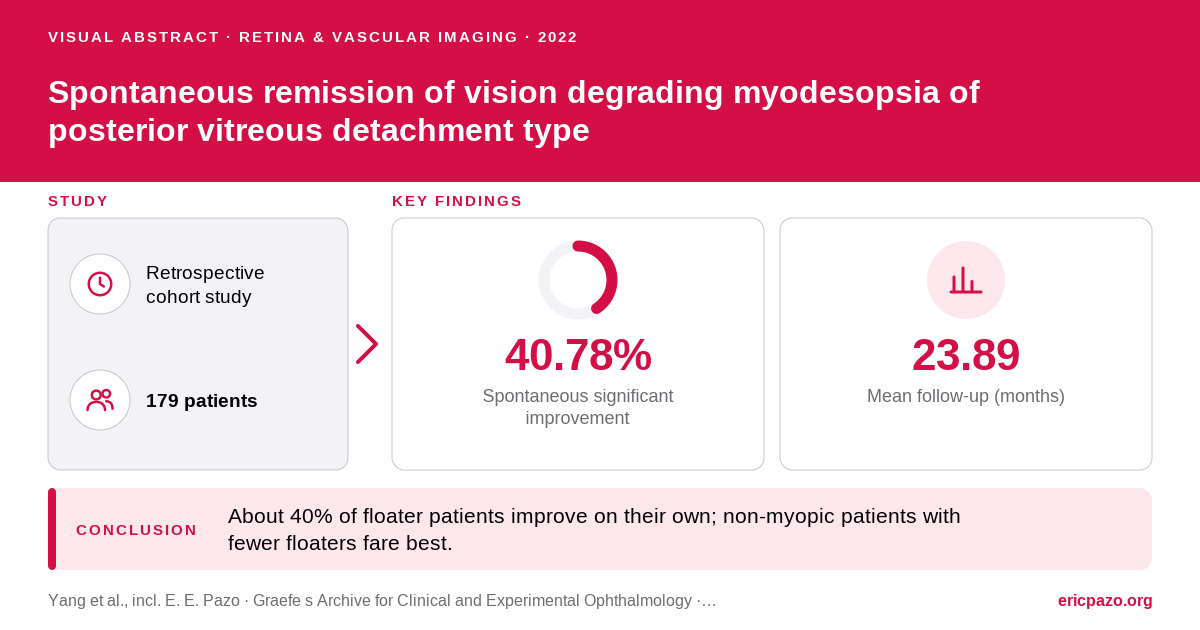
Environ 40 % des patients gênés par des corps flottants s'améliorent spontanément ; les non-myopes ayant moins de corps flottants évoluent le mieux.
- Type d'étude
- Étude de cohorte rétrospective
- Échantillon
- 179 patients
- Amélioration significative spontanée
- 40.78%
- Suivi moyen (mois)
- 23.89
Résumé
Ce résumé est affiché dans sa langue d'origine, l'anglais, car l'article n'est pas publié sous une licence ouverte autorisant les traductions.
Purpose The study aims to observe the spontaneous remission of posterior vitreous detachment (PVD)-type vision degrading myodesopsia (VDM) during long-term follow-up. Methods We retrospectively reviewed VDM patients with PVD type that refused any treatment. The ratio and time of significant spontaneous remission of floater symptoms occurring were described. The associated factors with significant remission of floater symptoms were analyzed in the univariate and multivariate logistic regression analyses. Results In total, 179 patients with VDM were assessed. The mean age of all patients was 60.56 ± 0.47 years old, and the mean duration of follow-up was 23.89 ± 6.63 months. Of the patients, 40.78% have significant improvement in their floater symptoms after mean 16.55 ± 10.63-month follow-up. Myopia (OR = 0.280, 95% CI = 0.084-0.932, P = 0.038), the number of floaters > 3 (OR = 0.343, 95% CI = 0.172-0.683, P = 0.002), and floaters with string-like pattern (OR = 0.370, 95% CI = 0.166-0.824, P = 0.015) and blocky pattern (OR = 0.299, 95% CI = 0.090-0.993, P = 0.049) were negatively correlated with the significant spontaneous remission of VDM symptoms in the multiple binary logistic regression analysis. Conclusions Approximately 40% of VDM patients with PVD may experience significant spontaneous remission during long-term follow-up. Patients that are non-myopic and with fewer floaters are more likely to feel relief from VDM symptoms. Floaters with string-like or blocky patterns are less likely to undergo spontaneous remission.
Mots-clés : posterior vitreous detachment; spontaneous regression; vitreous opacities; myopia; long-term follow-up
Accès
Comment citer
Afficher le BibTeX
@article{yang2022spontaneous,
  title = {{Spontaneous remission of vision degrading myodesopsia of posterior vitreous detachment type}},
  author = {Yang, Xing and Shi, Cheng and Liu, Qiang and Pazo, Emmanuel Eric and Lin, Tiezhu},
  journal = {Graefe s Archive for Clinical and Experimental Ophthalmology},
  year = {2022},
  doi = {10.1007/s00417-022-05948-4},
  url = {https://doi.org/10.1007/s00417-022-05948-4},
}
Travaux liés
- Association entre la pression de perfusion oculaire moyenne et la rétinopathie diabétique proliférante dans une population du nord de la Chine (2026)
- Association des connaissances et des attitudes vis-à-vis du traitement anti-VEGF avec l'interruption autodéclarée du traitement : une étude de classification à séparation temporelle (2026)
- Mesure automatisée par apprentissage profond du volume de rétinoschisis et de décollement dans la myopie pathologique avec contraction sclérale postérieure (2026)
- Développement d'un modèle prédictif fondé sur les cytokines de l'humeur aqueuse pour la réponse au traitement anti-VEGF dans l'œdème maculaire diabétique (2026)
- Répétabilité des mesures des photorécepteurs à cônes avec une ophtalmoscopie laser à balayage en optique adaptative commerciale (Mona II) chez des adultes en bonne santé (2026)