
Biomarqueurs inflammatoires sanguins chez les participants atteints de membranes épirétiniennes idiopathiques (titre courant : biomarqueurs sanguins de l'iERM)
Titre original : Blood Inflammatory Biomarkers in Participants with Idiopathic Epiretinal Membranes Running Title: Blood Biomarkers for iERM
Guanghao Qin, Yue You, Mingxin Shang, Wei He, Emmanuel Eric Pazo, Tiezhu Lin
Rétine et imagerie vasculaireCataracte et chirurgie du segment antérieur
En bref
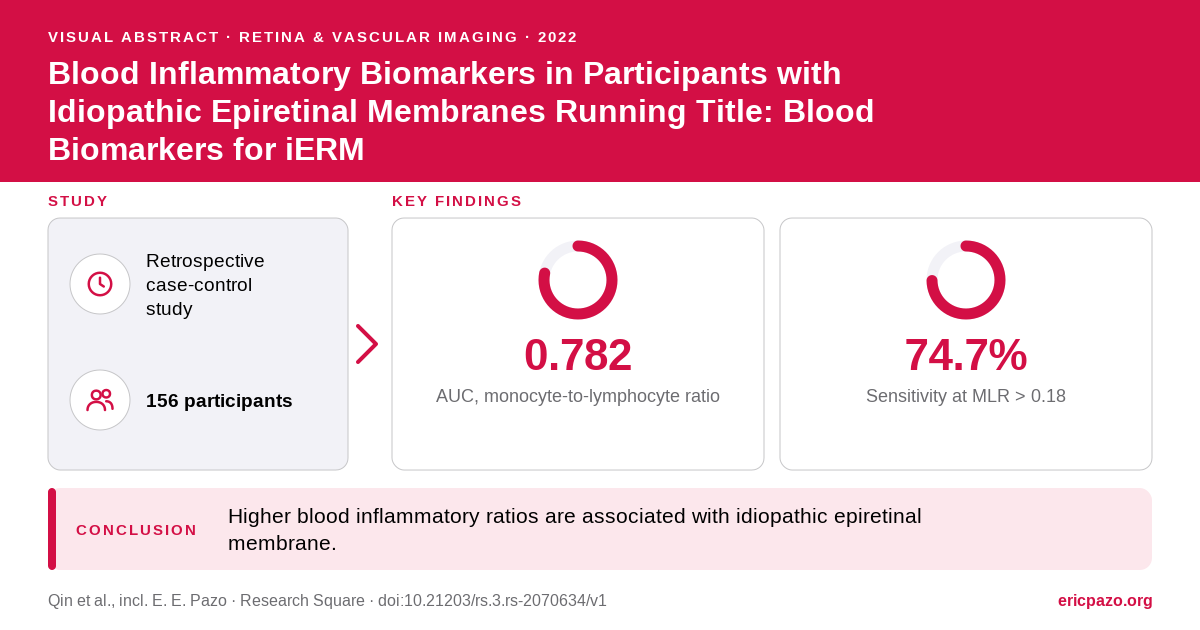
Des rapports inflammatoires sanguins plus élevés sont associés à la membrane épirétinienne idiopathique.
- Type d'étude
- Étude cas-témoins rétrospective
- Échantillon
- 156 participants
- AUC, rapport monocytes/lymphocytes
- 0.782
- Sensibilité pour MLR > 0.18
- 74.7%
Résumé
Résumé Objectif : Évaluer les rapports monocytes/lymphocytes (MLR), neutrophiles/lymphocytes (NLR) et plaquettes/lymphocytes (PLR) chez les patients atteints de membrane épirétinienne idiopathique (iERM). Méthodes : Cette étude rétrospective comprenait des participants atteints d'iERM et des participants atteints de cataracte. Les valeurs de MLR, NLR et PLR du sang périphérique ont été comparées entre les groupes. Le meilleur seuil de MLR, NLR et PLR dans l'iERM a été obtenu par analyse de courbes ROC, en déterminant le seuil optimal de chaque variable. Résultats : Au total, 95 participants atteints d'iERM ont été inclus dans le groupe d'étude et 61 participants atteints de cataracte sénile comme témoins. Le nombre de lymphocytes du groupe iERM était significativement plus faible que celui du groupe témoin (1.69±0.63 contre 1.95±0.53, p=0.003). Le nombre de monocytes du groupe iERM était significativement plus élevé que celui du groupe témoin (0.39±0.11 contre 0.31±0.10, p<0.001). Selon la courbe ROC, l'aire sous la courbe du MLR, du NLR et du PLR pour distinguer les patients atteints d'iERM des témoins était respectivement de 0.782, 0.645 et 0.657. Le meilleur seuil du MLR était >0.18, avec une sensibilité et une spécificité respectives de 74.7 % et 75.4 %. Celui du NLR était >2.06, avec une sensibilité et une spécificité de 50.5 % et 83.6 %. Celui du PLR était >95.89, avec une sensibilité et une spécificité de 86.3 % et 41.0 %. Conclusion : Les résultats de cette étude suggèrent qu'une inflammation systémique pourrait être associée à l'iERM. Les patients atteints d'iERM pourraient avoir tendance à présenter des valeurs élevées de MLR, NLR et PLR.
Traduit du résumé original en anglais (licence : CC BY).
Afficher le résumé original
Abstract Purpose: To evaluate the levels of monocyte to lymphocyte ratio (MLR), neutrophil to lymphocyte ratio (NLR) and platelet to lymphocyte ratio (PLR) in patients with Idiopathic Epiretinal Membrane (iERM). Methods:This retrospective study comprised of participants with iERM and participants with cataract. The values of MLR, NLR, PLR and from participants’ peripheral blood were assessed among groups. The best cutoff value of MLR, NLR, and PLR in iERM was found by performing a receiver operating characteristic (ROC) curve analysis and determining the optimum cutoff value for each variable. Results: In total, 95 participants with iERM were included in the study group, and 61 participants with senile cataract were included as controls. The lymphocyte count in the iERM group was significantly lower than the control group (1.69±0.63 vs. 1.95±0.53, p=0.003). The monocyte count in the iERM group was significantly higher thanthe control group (0.39±0.11 vs. 0.31±0.10, p<0.001). The area under the curve of MLR, NLR and PLR in differentiating patients with IERM and controls was 0.782, 0.645, and 0.657, respectively, according to ROC. The best cut-off value of MLR was >0.18, with sensitivity and specificity of 74.7% and 75.4% respectively. The NLR was >2.06, with a sensitivity and specificity of 50.5% and 83.6% respectively. The PLR was >95.89, with a sensitivity and specificity of 86.3% and 41.0% respectively. Conclusion:The findings of this study suggest that systemic inflammation may be associated with iERM. IERM patients may be prone to have high MLR, NLR and PLR values.
Mots-clés : idiopathic epiretinal membrane; inflammatory markers; monocyte-to-lymphocyte ratio; neutrophil-to-lymphocyte ratio; platelet-to-lymphocyte ratio; systemic inflammation; senile cataract; lymphocyte count
Accès
Comment citer
Afficher le BibTeX
@article{qin2022blood,
  title = {{Blood Inflammatory Biomarkers in Participants with Idiopathic Epiretinal Membranes Running Title: Blood Biomarkers for iERM}},
  author = {Qin, Guanghao and You, Yue and Shang, Mingxin and He, Wei and Pazo, Emmanuel Eric and Lin, Tiezhu},
  journal = {Research Square},
  year = {2022},
  doi = {10.21203/rs.3.rs-2070634/v1},
  url = {https://doi.org/10.21203/rs.3.rs-2070634/v1},
}
Travaux liés
- Biomarqueurs inflammatoires sanguins chez les participants atteints de membrane épirétinienne idiopathique : une étude rétrospective de série de cas (2023)
- Association entre la pression de perfusion oculaire moyenne et la rétinopathie diabétique proliférante dans une population du nord de la Chine (2026)
- Association des connaissances et des attitudes vis-à-vis du traitement anti-VEGF avec l'interruption autodéclarée du traitement : une étude de classification à séparation temporelle (2026)
- Mesure automatisée par apprentissage profond du volume de rétinoschisis et de décollement dans la myopie pathologique avec contraction sclérale postérieure (2026)
- Développement d'un modèle prédictif fondé sur les cytokines de l'humeur aqueuse pour la réponse au traitement anti-VEGF dans l'œdème maculaire diabétique (2026)