
Observaciones clínicas en la práctica real y análisis de biomarcadores del humor acuoso de los subtipos de edema macular diabético clasificados por OCT tras inyecciones intravítreas
Título original: Real-world clinical insights and aqueous humor biomarker analysis of diabetic macular edema subtypes classified by OCT following intravitreal injections
Liangzhang Tan, Shoukuan Liu, Wenrui Linghu, Yifeng Ke, Yongtao Li, Emmanuel Eric Pazo, Xinjun Ren
 BMC Ophthalmology, 2025 · artículo · doi:10.1186/s12886-025-04186-6 · citado 2 veces · Acceso abierto (CC BY-NC-ND)
De un vistazo
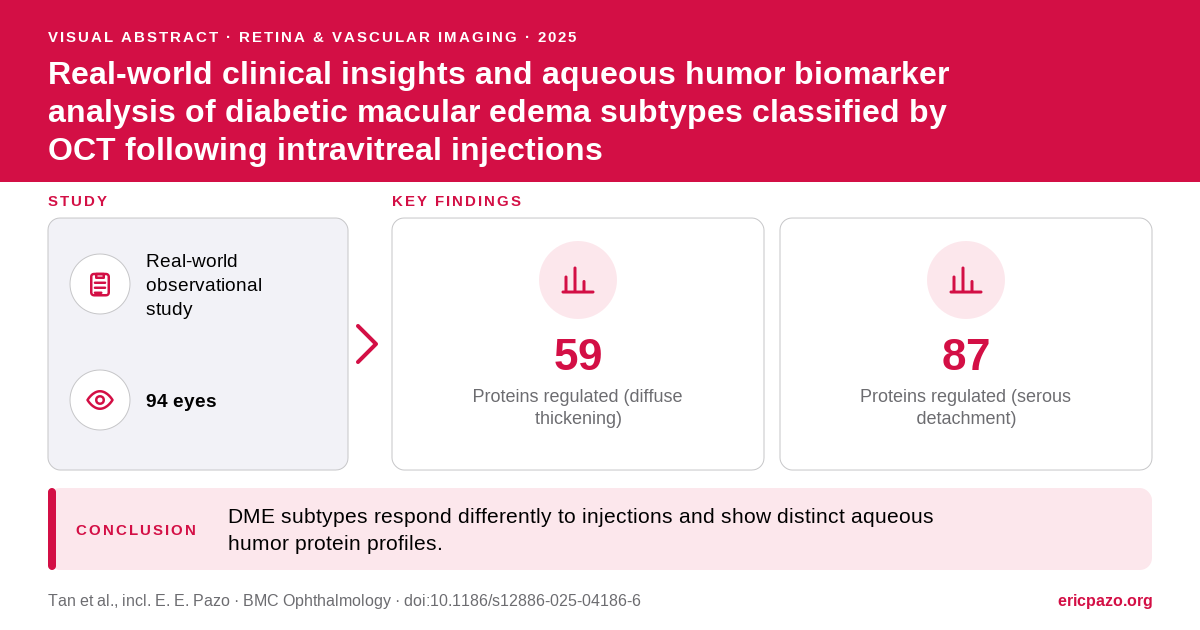
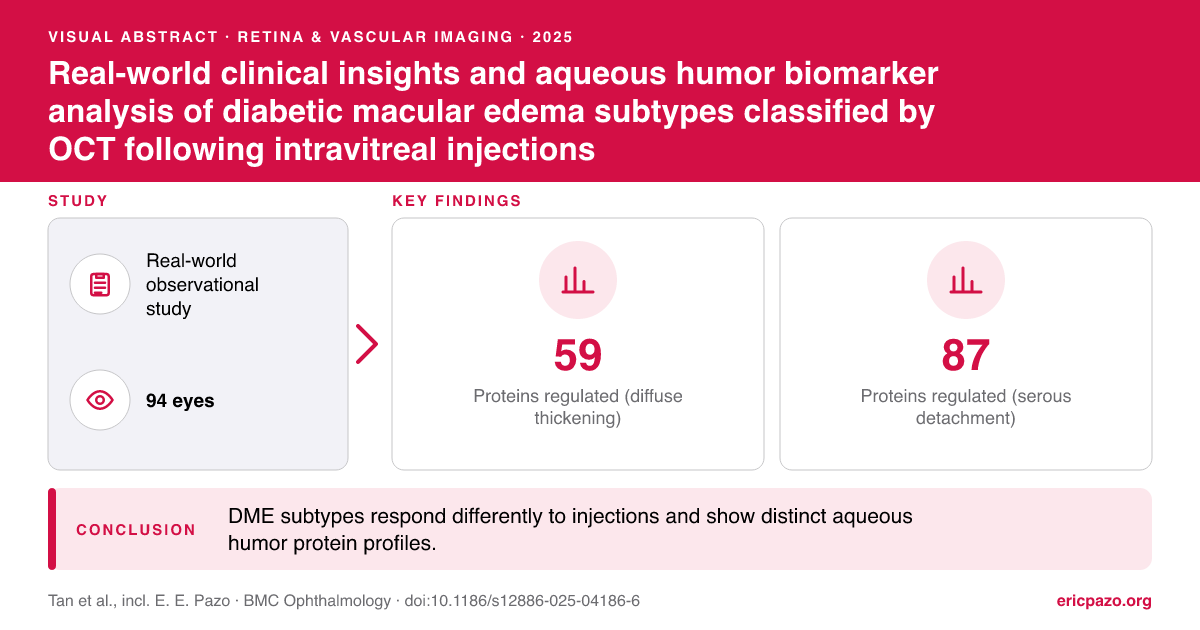
Los subtipos de EMD responden de forma distinta a las inyecciones y muestran perfiles proteicos distintos en el humor acuoso.
- Diseño
- Estudio observacional en la práctica real
- Muestra
- 94 ojos
- Proteínas reguladas (engrosamiento difuso)
- 59
- Proteínas reguladas (desprendimiento seroso)
- 87
Resumen
Este resumen se muestra en su idioma original, el inglés, porque la licencia del artículo (CC BY-NC-ND) no permite publicar traducciones.
PURPOSE: This study aimed to observe the morphological changes and visual outcomes in diabetic macular edema (DME) subtypes based on optical coherence tomography classification following intravitreal injection. METHODS: Ninety-four eyes from seventy-eight patients were enrolled between July 1, 2018, and June 30, 2023. Best-corrected visual acuity (BCVA), central subfield thickness, and morphological changes were examined at each follow-up visit. Aqueous humor samples were obtained before intravitreal injection of anti-vascular endothelial growth factor or cataract surgery. The inflammatory cytokine profile in the aqueous humor of each DME subtype was analyzed to explore potential contributions. RESULTS: The BCVA in the diffuse retinal thickening group was significantly improved at the last follow-up (p = 0.006), but no significant change in central subfield thickness was observed. Conversely, the BCVA in the cystoid macular edema and serous retinal detachment groups did not significantly improve, although a significant reduction in central subfield thickness was observed in both groups at the final follow-up (both p < 0.05). Principal component analysis of proteomic data revealed clear segregation between samples from patients with different DME subtypes and those from the control group. 59 proteins were found to be significantly regulated in the diffuse retinal thickening group compared to those in the control group. Of these, 10 proteins were upregulated, whereas 49 were downregulated. In the cystoid macular edema group, 30 proteins were significantly regulated, with 8 proteins upregulated and 22 downregulated. In the serous retinal detachment group, 87 proteins showed significant changes: 24 exhibited increased expression and 63 decreased expression. CONCLUSIONS: The diffuse retinal thickening subtype showed a better response and cystoid macular edema was the most common morphological subtype of DME after intravitreal injection treatment in real-world clinical observations. The variations in protein expression of aqueous humor suggested distinct pathological mechanisms for each DME subtype, laying the groundwork for more targeted treatment strategies.
Palabras clave: diabetic macular edema; aqueous humor biomarkers; intravitreal anti-VEGF injection; cystoid macular edema; serous retinal detachment; central subfield thickness; best-corrected visual acuity; inflammatory cytokines
Acceso
Cómo citar
Mostrar BibTeX
@article{tan2025real,
  title = {{Real-world clinical insights and aqueous humor biomarker analysis of diabetic macular edema subtypes classified by OCT following intravitreal injections}},
  author = {Tan, Liangzhang and Liu, Shoukuan and Linghu, Wenrui and Ke, Yifeng and Li, Yongtao and Pazo, Emmanuel Eric and Ren, Xinjun},
  journal = {BMC Ophthalmology},
  year = {2025},
  doi = {10.1186/s12886-025-04186-6},
  url = {https://doi.org/10.1186/s12886-025-04186-6},
}
Trabajos relacionados
- Asociación entre la presión de perfusión ocular media y la retinopatía diabética proliferativa en una población del norte de China (2026)
- Asociación de los conocimientos y actitudes sobre el tratamiento anti-VEGF con la interrupción autodeclarada del tratamiento: un estudio de clasificación con separación temporal (2026)
- Medición automatizada basada en aprendizaje profundo del volumen de retinosquisis y desprendimiento en la miopía patológica con contracción escleral posterior (2026)
- Desarrollo de un modelo predictivo basado en datos de citocinas del humor acuoso para la respuesta al tratamiento anti-VEGF en el edema macular diabético (2026)
- Repetibilidad de las métricas de fotorreceptores de tipo cono con una oftalmoscopia láser de barrido con óptica adaptativa comercial (Mona II) en adultos sanos (2026)