
La función cognitiva se correlaciona con los parámetros de imagen estructurales y vasculares de la retina en adultos mayores chinos
Título original: Cognitive function correlates with retinal structural and vascular imaging parameters in Chinese older adults
Manqiao Wang, Li-Mei Chen, Yi Gong, Emmanuel Eric Pazo, Fei Gao, Liying Hu, Chen Chen, Yan Xia Shao, Juping Liu, Xiaorong Li
 Alzheimer s & Dementia Diagnosis Assessment & Disease Monitoring, 2025 · artículo · doi:10.1002/dad2.70147 · citado 2 veces · Acceso abierto (CC BY-NC-ND)
De un vistazo
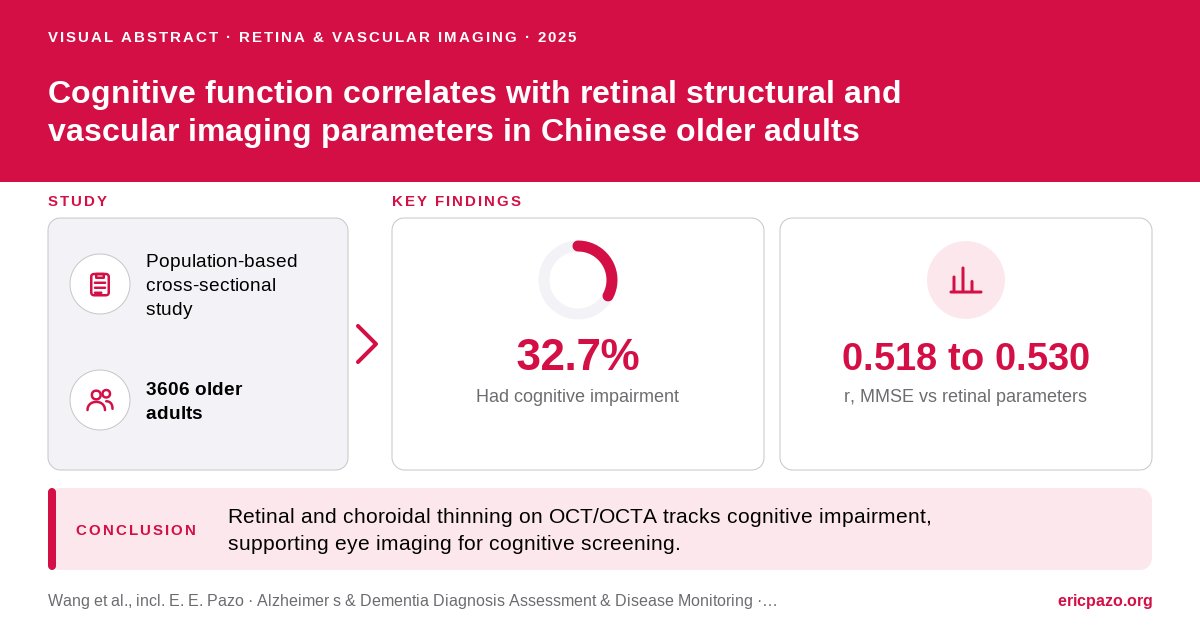
El adelgazamiento retiniano y coroideo en OCT/OCTA acompaña al deterioro cognitivo, lo que respalda el uso de imágenes oculares para el cribado cognitivo.
- Diseño
- Estudio transversal poblacional
- Muestra
- 3606 adultos mayores
- Presentaban deterioro cognitivo
- 32.7%
- r, MMSE frente a parámetros retinianos
- 0.518 to 0.530
Resumen
Este resumen se muestra en su idioma original, el inglés, porque la licencia del artículo (CC BY-NC-ND) no permite publicar traducciones.
Abstract AIM To investigate associations between cognitive status and retinal parameters in older adults. METHODS The population‐based Beichen Eye Study (BCES) recruited 5840 older adults from Tianjin, China. Retinal thickness and vessel density (VD) were measured using optical coherence tomography angiography (OCT/OCTA). Cognitive function was assessed via the Mini‐Mental State Examination (MMSE). Participants with gradable images and valid MMSE scores (n = 3606) were analyzed. RESULTS Cognitive impairment (CI) was identified in 32.7% of participants. Compared to non‐CI individuals, those with CI exhibited reduced average retinal thickness (p = 0.007) and choroid thickness (p < 0.001). Superficial VD (VDSVP) was significantly higher in moderate to severe CI compared to mild CI (p = 0.030). Linear mixed‐effects regression demonstrated positive correlations between MMSE scores and retinal parameters (r = 0.518 to 0.530). CONCLUSION Retinal thinning may occur in mild CI, with VD changes as CI progresses. Choroidal thinning is a potential cognitive indicator. OCT/OCTA, as a non‐invasive tool, offers potential for early cognitive disorder screening in aging populations. Highlights Retinal thinning (average retinal thickness: p = 0.007) and choroidal thinning (p < 0.001) are significantly associated with CI in older adults. A paradoxical increase in VDSVP was observed in moderate to severe CI (p = 0.030), suggesting compensatory vascular remodeling. Choroidal thickness emerges as a robust biomarker for cognitive decline (correlation coefficient range: 0.518 to 0.530). The large‐scale population‐based study (n = 5840) was conducted integrating OCT/OCTA imaging with MMSE cognitive assessments. The study supports OCT/OCTA as a noninvasive, cost‐effective screening tool for early detection of cognitive disorders in resource‐limited settings. The study highlights vascular risk management (e.g., glycemic control, smoking cessation) as a dual target for retinal and cognitive health.
Palabras clave: cognitive impairment; retinal thickness; choroidal thickness; vessel density; retinal vascular remodeling; cognitive decline biomarkers; older adults; optical coherence tomography angiography
Acceso
Cómo citar
Mostrar BibTeX
@article{wang2025cognitive,
  title = {{Cognitive function correlates with retinal structural and vascular imaging parameters in Chinese older adults}},
  author = {Wang, Manqiao and Chen, Li-Mei and Gong, Yi and Pazo, Emmanuel Eric and Gao, Fei and Hu, Liying and Chen, Chen and Shao, Yan Xia and Liu, Juping and Li, Xiaorong},
  journal = {Alzheimer s & Dementia Diagnosis Assessment & Disease Monitoring},
  year = {2025},
  doi = {10.1002/dad2.70147},
  url = {https://doi.org/10.1002/dad2.70147},
}
Trabajos relacionados
- Asociación entre la presión de perfusión ocular media y la retinopatía diabética proliferativa en una población del norte de China (2026)
- Asociación de los conocimientos y actitudes sobre el tratamiento anti-VEGF con la interrupción autodeclarada del tratamiento: un estudio de clasificación con separación temporal (2026)
- Medición automatizada basada en aprendizaje profundo del volumen de retinosquisis y desprendimiento en la miopía patológica con contracción escleral posterior (2026)
- Desarrollo de un modelo predictivo basado en datos de citocinas del humor acuoso para la respuesta al tratamiento anti-VEGF en el edema macular diabético (2026)
- Repetibilidad de las métricas de fotorreceptores de tipo cono con una oftalmoscopia láser de barrido con óptica adaptativa comercial (Mona II) en adultos sanos (2026)