
Validity of OSDI-6 questionnaire in a Chinese adult population
Guanghao Qin, Salissou Moutari, Jiayan Chen, Ling Xu, Wei He, Xingru He, Emmanuel Eric Pazo, Sile Yu
 Scientific Reports, 2024 · article · doi:10.1038/s41598-024-64953-1 · cited by 8 · Open access (CC BY)
At a glance
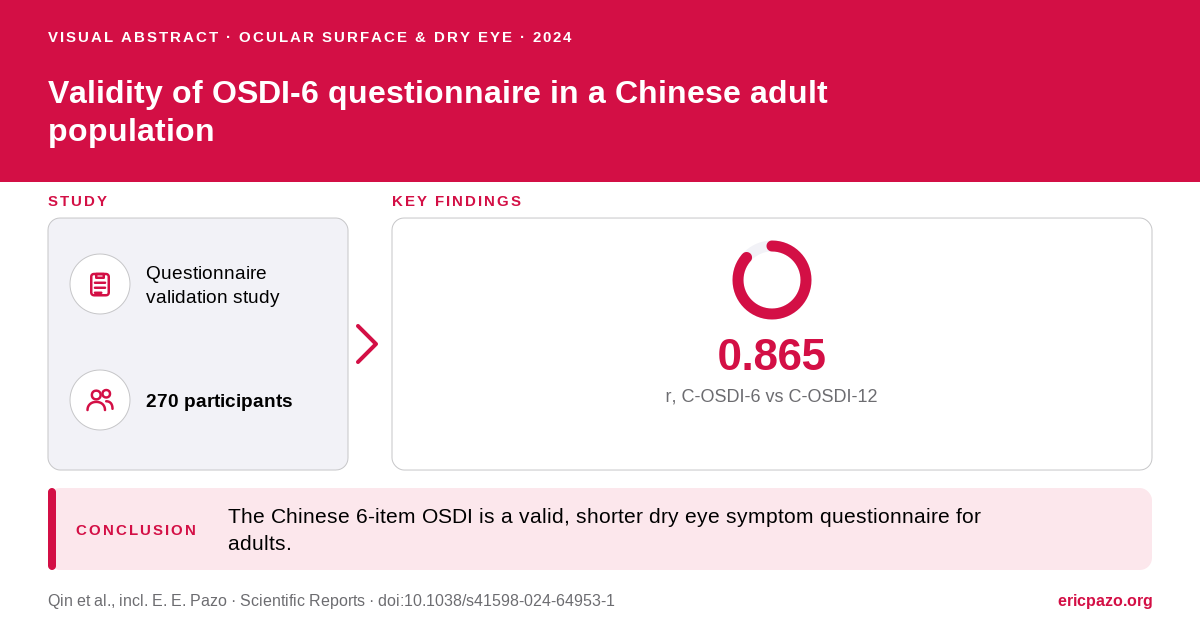
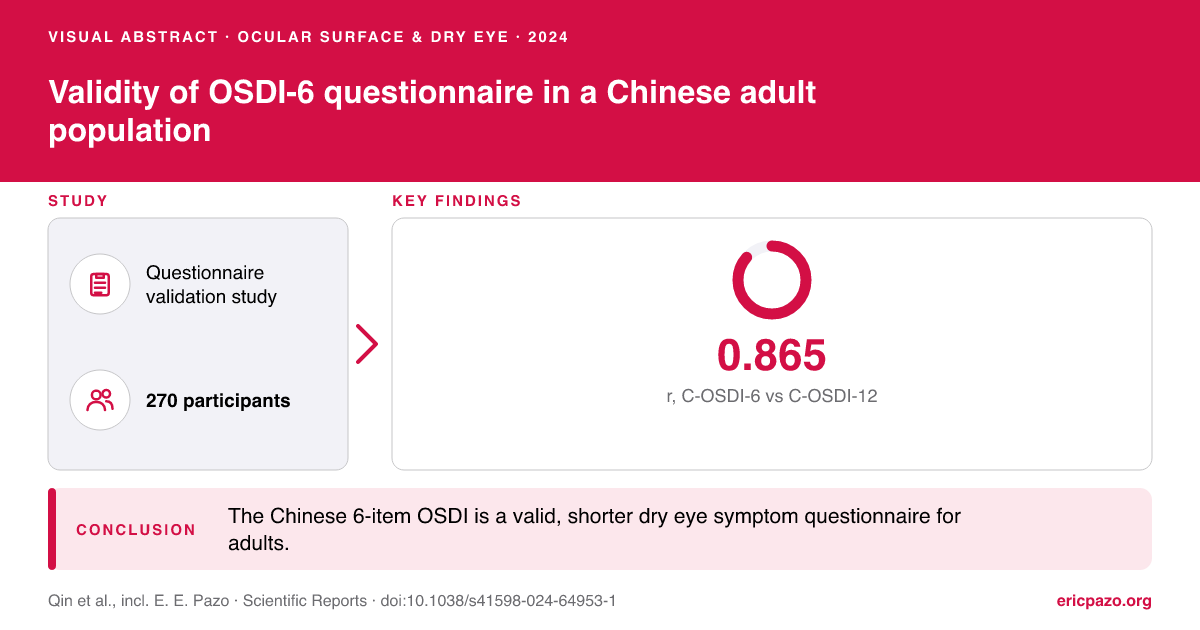
The Chinese 6-item OSDI is a valid, shorter dry eye symptom questionnaire for adults.
- Design
- Questionnaire validation study
- Sample
- 270 participants
- r, C-OSDI-6 vs C-OSDI-12
- 0.865
Abstract
This study aimed to evaluate the validity of the Chinese translation version of OSDI-6 (C-OSDI-6) using a virtual set-up questionnaire for dry eye disease. A total of 270 participants (136 males, 50.4% and 134 females, 49.6%) with a mean age of 28.22 ± 9.01 years were assessed, diagnosed under the criteria put forth by Dry Eye Workshop completed the Chinese translated version of the OSDI-12 questionnaire (C-OSDI-12). Validity and psychometric properties were analyzed using the study data on the selected items (a new approach called virtual validation). The six items were extracted from the C-OSDI-12 as suggested by the authors of OSDI-6 and compared. The total scores of C-OSDI-12 and C-OSDI-6 were 30.27 ± 13.19 and 6.95 ± 3.53, respectively. Significant reliability was found between the total C-OSDI-6 score and the total C-OSDI-12 score (r = 0.865, p < 0.001). Infits and outfits of the C-OSDI-6 were between 1.26 and 0.78.The C-OSDI-6 proved valid and psychometrically responsive in Chinese adult dry eye participants. The findings of this virtual validation study need to be confirmed in a longitudinal validation study on real-world use.
Keywords: dry eye; Chinese translation; questionnaire validity; virtual validation; psychometric properties; patient-reported outcomes; Chinese adults
Access
How to cite
Show BibTeX
@article{qin2024validity,
  title = {{Validity of OSDI-6 questionnaire in a Chinese adult population}},
  author = {Qin, Guanghao and Moutari, Salissou and Chen, Jiayan and Xu, Ling and He, Wei and He, Xingru and Pazo, Emmanuel Eric and Yu, Sile},
  journal = {Scientific Reports},
  year = {2024},
  doi = {10.1038/s41598-024-64953-1},
  url = {https://doi.org/10.1038/s41598-024-64953-1},
}
Related work
- An Analysis of the Influence of Flap Margin Space on Corneal Nerve Regeneration After Femtosecond Laser–Assisted LASIK (2026)
- Comparison between the Effect of Intense Pulsed Light and Lid Hygiene on the Tear Film and Ocular Surface: A Randomized Controlled Study (2026)
- Effects of 3% diquafosol sodium on tear film stability, corneal aberration parameters, and vision-related quality of life in pediatric orthokeratology-associated dry eye disease (2026)
- Association Between Maternal Pre-Pregnancy Body Mass Index and Astigmatism and Corneal Curvature in Offspring: A Cross-Sectional Study (2025)
- Differential Expression of Tear Lymphotoxin-Α, Immunoglobulin E, and Matrix Metalloproteinase-9 in Allergic Conjunctivitis-Associated Dry Eye (2025)