
強パルス光による緑内障関連ドライアイの管理:ランダム化比較研究
原題: Management of Glaucoma-Related Dry Eye Disease with Intense Pulsed Light: A Randomized Control Study
Hongda Zhang, Yifan Qi, Jiayan Chen, Guanghao Qin, Ling Xu, Wei He, Sile Yu, Huixin Che, Emmanuel Eric Pazo
 Clinical ophthalmology, 2024 · 原著論文 · doi:10.2147/opth.s471426 · 被引用 5 回 · オープンアクセス(CC BY-NC)
要点
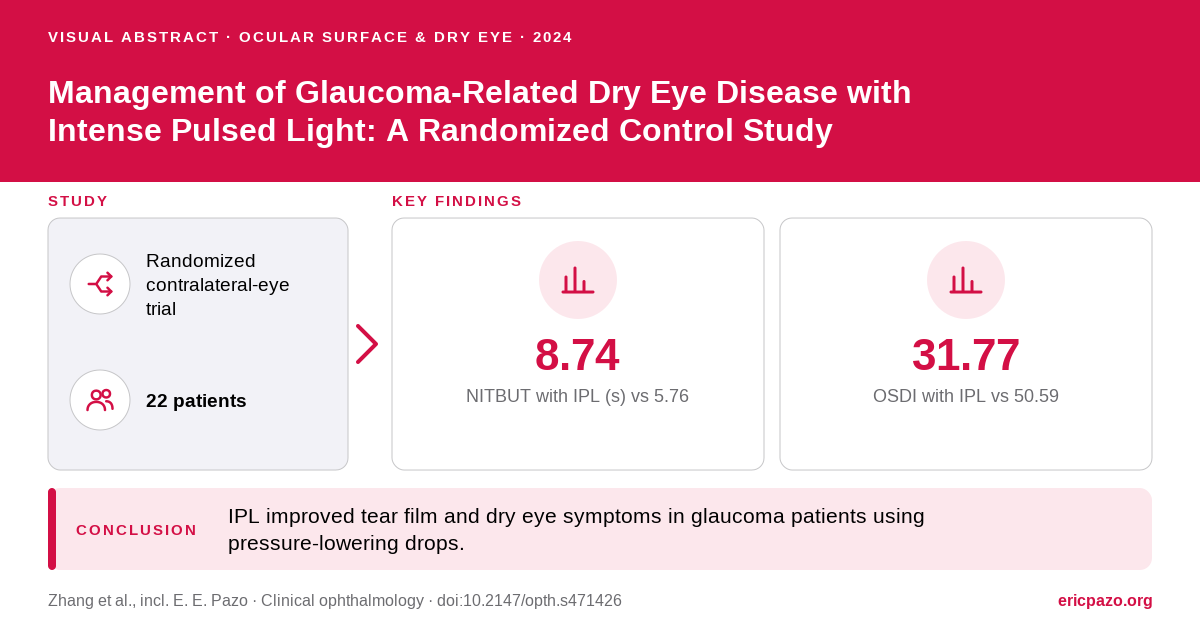
IPL は、眼圧下降薬を点眼している緑内障患者の涙液層とドライアイ症状を改善した。
- 研究デザイン
- 僚眼対照ランダム化試験
- 対象
- 患者 22 人
- IPL 群の NITBUT(秒)対 5.76
- 8.74
- IPL 群の OSDI 対 50.59
- 31.77
抄録
目的:本研究の目的は、緑内障とドライアイ(DED)と診断された患者における強パルス光(IPL)療法の有効性を評価することであった。方法:本ランダム化比較研究では、33 歳から 82 歳の緑内障と診断された 22 人を登録した。参加者は眼圧下降薬を点眼中で、ドライアイに関連する臨床所見と自覚症状があった。各患者は片眼に 3 回の IPL 治療を受け、僚眼を対照眼(CT)とした。ベースライン、2 週、4 週の 3 時点で以下のパラメータを評価した:非侵襲的涙液層破壊時間(NITBUT)、涙液メニスカス高(TMH)、角結膜上皮染色スコア(CS)、涙液層脂質層(TFLL)、マイボーム腺圧出スコア(MGEx)、シルマー I 試験、眼球結膜発赤スコア(OBRS)、Ocular Surface Disease Index(OSDI)。安全性の評価として眼圧(IOP)、最高矯正視力(BCVA)、角膜内皮細胞数(ECC)を測定した。本臨床試験は 25/12/2023 に ClinicalTrials.gov に登録された(NCT06158984)。結果:ベースラインと 4 週の測定値を比較すると、IPL 群では NITBUT(IPL:8.74± 2.60 秒 対 CT:5.76± 1.75 秒、p < 0.01)、TMH(IPL:0.23± 0.05mm 対 CT:0.19± 0.06mm、p =0.011)、C.S.(IPL:1.14± 0.56 対 CT:1.95± 1.17、p =0.005)、TFLL(IPL:2.91± 2.91 対 CT:3.36± 0.58、p =0.047)、MGEx スコア(IPL:1.14± 0.35 対 CT:1.45± 0.51、p =0.020)、OSDI スコア(IPL:31.77± 15.59 対 50.59± 21.55、p =0.002)が有意に改善した。一方、その他のパラメータに有意な改善はなかった( p > 0.05)。結論:緑内障点眼薬を使用している患者の眼表面疾患は、対処しなければ悪化する可能性がある。しかし、IPL 療法はドライアイの客観的・主観的指標の両方を有意に改善しうる。最高矯正視力、内皮細胞数、眼圧は許容範囲内であった。研究期間中に有害事象は報告されなかった。平易な要約:緑内障の点眼薬を使っている人は、問題に対処しないと眼表面の病気が悪化する可能性があることが示された。一方、IPL 治療はドライアイの客観的・主観的な検査の両方で大きな改善をもたらしうる。IPL 治療後も、視力、内皮細胞数、眼の中の圧力はすべて正常範囲内であった。ただし、本研究の参加者は緑内障があり 1 年間緑内障の薬を使っていたこと、また症状が長く続くことも結果に影響した可能性がある。さらに、緑内障の薬によるドライアイは複雑で、同じ病期でも症状や所見はさまざまである。また、自覚症状が臨床所見と一致しないこともある。緑内障治療薬の種類、量、使用期間が結果に影響した可能性もある。キーワード:緑内障、強パルス光、ドライアイ、マイボーム腺、緑内障関連ドライアイ
英語の原文抄録からの翻訳です(ライセンス:CC BY-NC)。
原文の抄録を表示
Purpose: The objective of this study was to assess the effectiveness of intense pulsed light (IPL) therapy in individuals diagnosed with glaucoma and dry eye disease (DED). Methods: This randomized control study recruited 22 individuals diagnosed with glaucoma, ranging in age from 33 to 82 years. These participants were undergoing treatment with hypotensive eyedrops and had clinical indications and subjective complaints associated with dry eye. Each patient underwent three sessions of IPL therapy in one eye, while the contralateral eye served as the control eye (CT). The following parameters were assessed at three time points: baseline, week-2, and week-4. These parameters include non-invasive breakup time (NITBUT), tear meniscus height (TMH), conjunctivocorneal epithelial staining score (CS), tear film lipid layer (TFLL), meibomian gland expressibility score (MGEx), Schirmer I test, ocular bulbar redness score (OBRS), and ocular surface disease index (OSDI). Intraocular pressure (IOP), best-corrected visual acuity (BCVA), and corneal endothelial cell count (ECC) were assessed for safety. The clinical trial was registered on 25/12/2023 at ClinicalTrials.gov website (NCT06158984). Results: Comparing baseline and 4-week measurements revealed that the IPL group found significant improvements in NITBUT (IPL: 8.74± 2.60 sec. vs CT: 5.76± 1.75 sec. p < 0.01), TMH (IPL: 0.23± 0.05mm vs CT: 0.19± 0.06mm, p =0.011), C.S. (IPL: 1.14± 0.56 vs CT: 1.95± 1.17, p =0.005), TFLL (IPL: 2.91± 2.91 vs CT:3.36± 0.58, p =0.047), MGEx score (IPL: 1.14± 0.35 vs CT: 1.45± 0.51, p =0.020) and OSDI scores (IPL: 31.77± 15.59 vs 50.59± 21.55, p =0.002) significantly improved. Conversely, other parameters showed no significant improvements ( p > 0.05). Conclusion: The progression of ocular surface disease in individuals using topical anti-glaucoma medication may worsen if the condition is not addressed. Nevertheless, IPL therapy has the potential to result in significant improvements in both objective and subjective measures of dry eye. Best-corrected visual acuity, endothelial cell count, and intraocular pressure were determined to be within the permitted limits. No adverse events were reported during the course of the study. Plain Language Summary: The results show that people who use topical medicines to treat glaucoma may get worse eye surface disease if they do not treat the problem. IPL treatment, on the other hand, can make a big difference in both objective and subjective dry eye tests. The vision, endothelial cell count, and the pressure inside the eye were all found to be within normal limits after the IPL treatment. Even though the people in our study had glaucoma and had been taking glaucoma medicine for it for a year and the fact that the symptoms last for a long time may also change the results. Also, DED caused by glaucoma medication is complicated, with a lot of different symptoms and signs, even in the same stage. Also, subjective complaints may not match up with clinical signs. The type, amount, and length of anti-glaucoma drugs may have affected the results. Keywords: glaucoma, intense pulsed light, dry eye, meibomian glands, glaucoma-related dry eye
キーワード: intense pulsed light therapy; glaucoma; dry eye; meibomian gland dysfunction; ocular surface disease; tear film break-up time; tear meniscus height; meibomian gland expressibility
アクセス
引用方法
BibTeX を表示
@article{zhang2024management,
  title = {{Management of Glaucoma-Related Dry Eye Disease with Intense Pulsed Light: A Randomized Control Study}},
  author = {Zhang, Hongda and Qi, Yifan and Chen, Jiayan and Qin, Guanghao and Xu, Ling and He, Wei and Yu, Sile and Che, Huixin and Pazo, Emmanuel Eric},
  journal = {Clinical ophthalmology},
  year = {2024},
  doi = {10.2147/opth.s471426},
  url = {https://doi.org/10.2147/opth.s471426},
}