
ドライアイの徴候と症状に対する強パルス光療法の有効性:メタ解析とシステマティックレビュー
原題: Efficacy of intense pulsed light therapy on signs and symptoms of dry eye disease: A meta-analysis and systematic review
Guanghao Qin, Jiayan Chen, Liangzhe Li, Qing Zhang, Ling Xu, Sile Yu, Wei He, Xingru He, Emmanuel Eric Pazo
 Indian Journal of Ophthalmology, 2023 · 総説 · doi:10.4103/ijo.ijo_2987_22 · 被引用 35 回 · オープンアクセス(CC BY-NC-SA)
要点
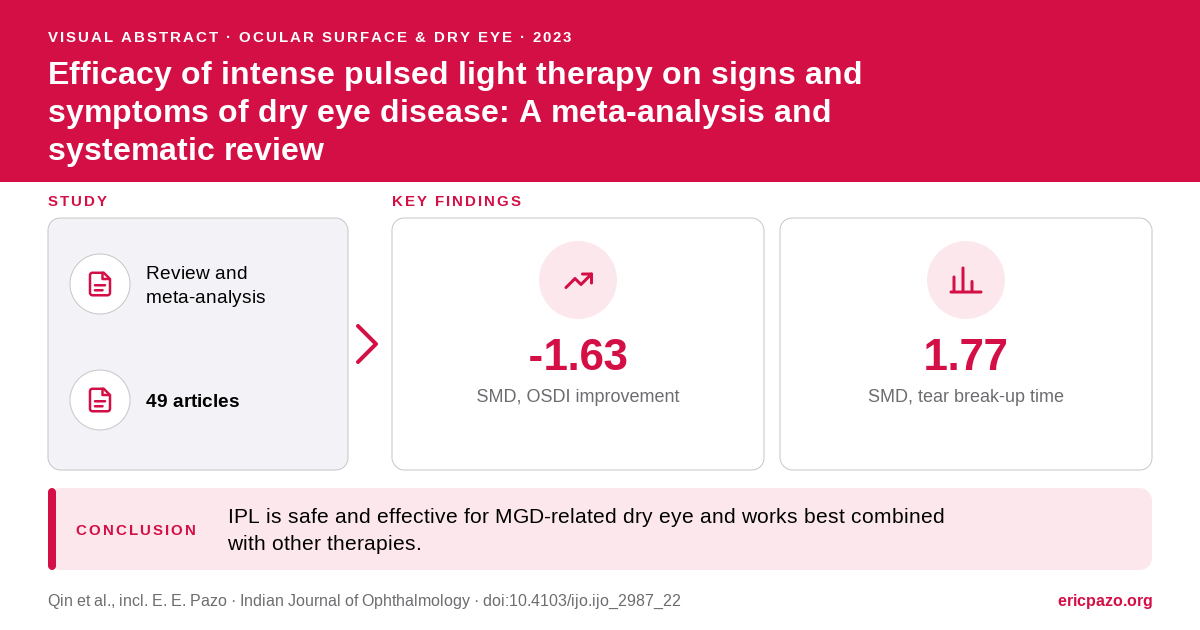
IPL は MGD 関連ドライアイに安全かつ有効であり、他の治療との併用で最も効果を発揮する。
- 研究デザイン
- レビューとメタ解析
- 対象
- 49 論文
- SMD(OSDI の改善)
- -1.63
- SMD(涙液層破壊時間)
- 1.77
抄録
本研究は、ドライアイ(DED)の治療における強パルス光(IPL)の有効性と安全性をレビューした。文献検索には PubMed データベースを用い、キーワードは "intense pulsed light" と "dry eye disease" とした。著者らが関連性を評価した後、49 論文をレビューした。全体として、いずれの治療法もドライアイ(DE)の徴候と症状の軽減に臨床的に有効であることが示されたが、改善の程度と効果の持続性には差があった。メタ解析では、治療後の Ocular Surface Disease Index(OSDI)スコアに有意な改善がみられ、標準化平均差(SMD)= -1.63、信頼区間(CI):-2.42 ~ -0.84 であった。さらに、メタ解析では涙液層破壊時間(TBUT)検査値にも有意な改善がみられ、SMD = 1.77、CI:0.49 ~ 3.05 であった。研究によれば、マイボーム腺圧出(MGX)、ヒアルロン酸ナトリウム点眼、温熱アイマスク、温罨法、眼瞼清拭、瞼縁スクラブ、眼瞼マッサージ、抗菌薬点眼、シクロスポリン点眼、オメガ 3 サプリメント、ステロイド点眼、温罨法などの追加療法を IPL と併用すると、相乗的により高い効果が得られることがわかっている。ただし、臨床現場ではその実施可能性と費用対効果を考慮する必要がある。現在の知見では、コンタクトレンズ使用の減量・中止、潤滑点眼薬・ゲル、温罨法・アイマスクなどの生活習慣の改善で DE の徴候と症状が改善しない場合に IPL 療法が適しているとされる。さらに、IPL 療法の効果は数か月以上持続するため、アドヒアランスに問題のある患者にも十分な利益がある。DED は多因子性の疾患であり、IPL 療法はマイボーム腺機能不全(MGD)関連 DE の徴候と症状の軽減において安全かつ効率的であることがわかっている。治療プロトコルは著者によって異なるものの、現在の知見は IPL が MGD 関連 DE の徴候と症状に好ましい効果をもつことを示している。ただし、早期の患者のほうが IPL 療法からより大きな利益を得られる。さらに、IPL は他の従来の治療と併用することで維持効果が高まる。IPL の費用効用分析を評価するためのさらなる研究が必要である。
英語の原文抄録からの翻訳です(ライセンス:CC BY-NC-SA)。
原文の抄録を表示
This study reviewed the efficacy and safety of intense pulsed light (IPL) for the treatment of dry eye disease (DED). The PubMed database was used to conduct the literature search, which used the keywords "intense pulsed light" and "dry eye disease". After the authors evaluated the articles for relevancy, 49 articles were reviewed. In general, all treatment modalities were proven to be clinically effective in reducing dry eye (DE) signs and symptoms; however, the level of improvement and persistence of outcomes differed amongst them. Meta-analysis indicated significant improvement in the Ocular Surface Disease Index (OSDI) scores post-treatment with a standardized mean difference (SMD) = -1.63; confidence interval (CI): -2.42 to -0.84. Moreover, a meta-analysis indicated a significant improvement in tear break-up time (TBUT) test values with SMD = 1.77; CI: 0.49 to 3.05. Research suggests that additive therapies, such as meibomian gland expression (MGX), sodium hyaluronate eye drops, heated eye mask, warm compress, lid hygiene, lid margin scrub, eyelid massage, antibiotic drops, cyclosporine drops, omega-3 supplements, steroid drops, and warm compresses along with IPL, have been found to work in tandem for greater effectiveness; however, in clinical practice, its feasibility and cost-effectiveness have to be taken into consideration. Current findings suggest that IPL therapy is suitable when lifestyle modifications such as reducing or eliminating the use of contact lenses, lubricating eye drops/gels, and warm compresses/eye masks fail to improve signs and symptoms of DE. Moreover, patients with compliance issues have been shown to benefit well as the effects of IPL therapy is sustained for over several months. DED is a multifactorial disorder, and IPL therapy has been found to be safe and efficient in reducing its signs and symptoms of meibomian gland dysfunction (MGD)-related DE. Although the treatment protocol varies among authors, current findings suggest that IPL has a positive effect on the signs and symptoms of MGD-related DE. However, patients in the early stages can benefit more from IPL therapy. Moreover, IPL has a better maintenance impact when used in conjunction with other traditional therapies. Further research is needed to assess cost-utility analysis for IPL.
キーワード: intense pulsed light therapy; dry eye; meibomian gland dysfunction; Ocular Surface Disease Index; tear film break-up time; adjunctive therapy; meibomian gland expression; cyclosporine
アクセス
引用方法
BibTeX を表示
@article{qin2023efficacy,
  title = {{Efficacy of intense pulsed light therapy on signs and symptoms of dry eye disease: A meta-analysis and systematic review}},
  author = {Qin, Guanghao and Chen, Jiayan and Li, Liangzhe and Zhang, Qing and Xu, Ling and Yu, Sile and He, Wei and He, Xingru and Pazo, Emmanuel Eric},
  journal = {Indian Journal of Ophthalmology},
  year = {2023},
  doi = {10.4103/ijo.ijo_2987_22},
  url = {https://doi.org/10.4103/ijo.ijo_2987_22},
}
関連する論文
- フェムトセカンドレーザー併用 LASIK 後の角膜神経再生に対するフラップ縁間隙の影響の解析 (2026)
- 強パルス光と眼瞼清拭が涙液層と眼表面に及ぼす効果の比較:ランダム化比較試験 (2026)
- Effects of 3% diquafosol sodium on tear film stability, corneal aberration parameters, and vision-related quality of life in pediatric orthokeratology-associated dry eye disease (2026)
- 母親の妊娠前 BMI と子の乱視および角膜曲率との関連:横断研究 (2025)
- アレルギー性結膜炎に伴うドライアイにおける涙液中リンホトキシン α、免疫グロブリン E、マトリックスメタロプロテイナーゼ-9 の発現の違い (2025)