
Biomarcadores inflamatorios sanguíneos en participantes con membrana epirretiniana idiopática: un estudio retrospectivo de serie de casos
Título original: Blood inflammatory biomarkers in participants with idiopathic epiretinal membrane: A retrospective case series study
Guanghao Qin, Tiezhu Lin, Yue You, Mingxin Shang, Wei He, Emmanuel Eric Pazo
 Medicine, 2023 · artículo · doi:10.1097/md.0000000000034225 · citado 2 veces · Acceso abierto (CC BY)
Retina e imagen vascularCataratas y cirugía del segmento anterior
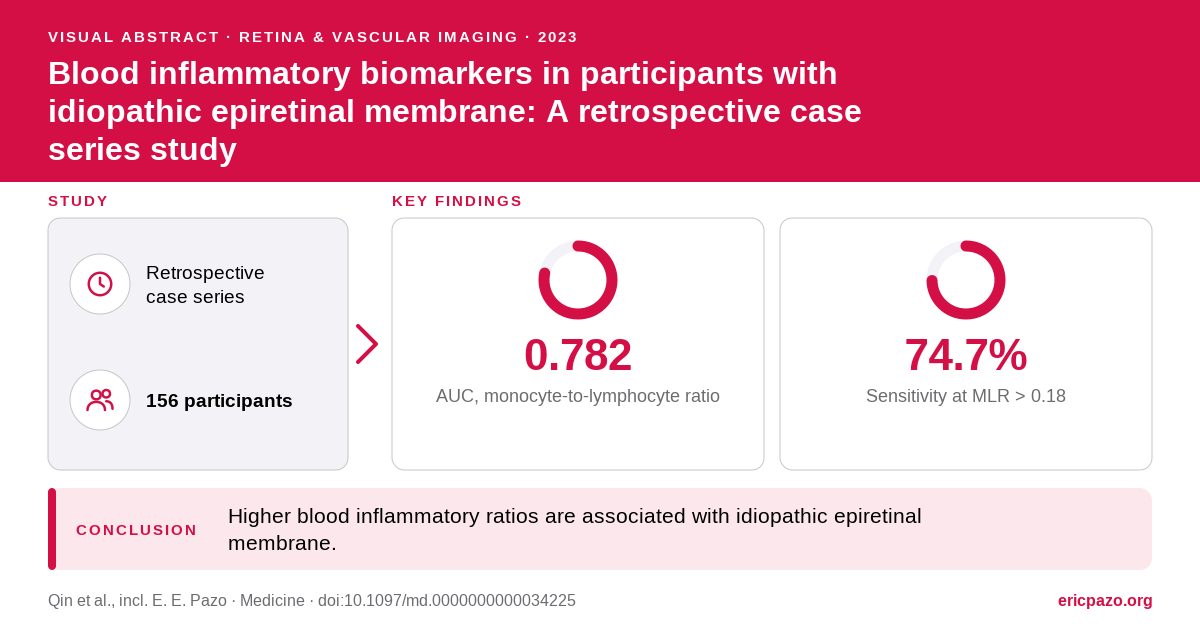
De un vistazo
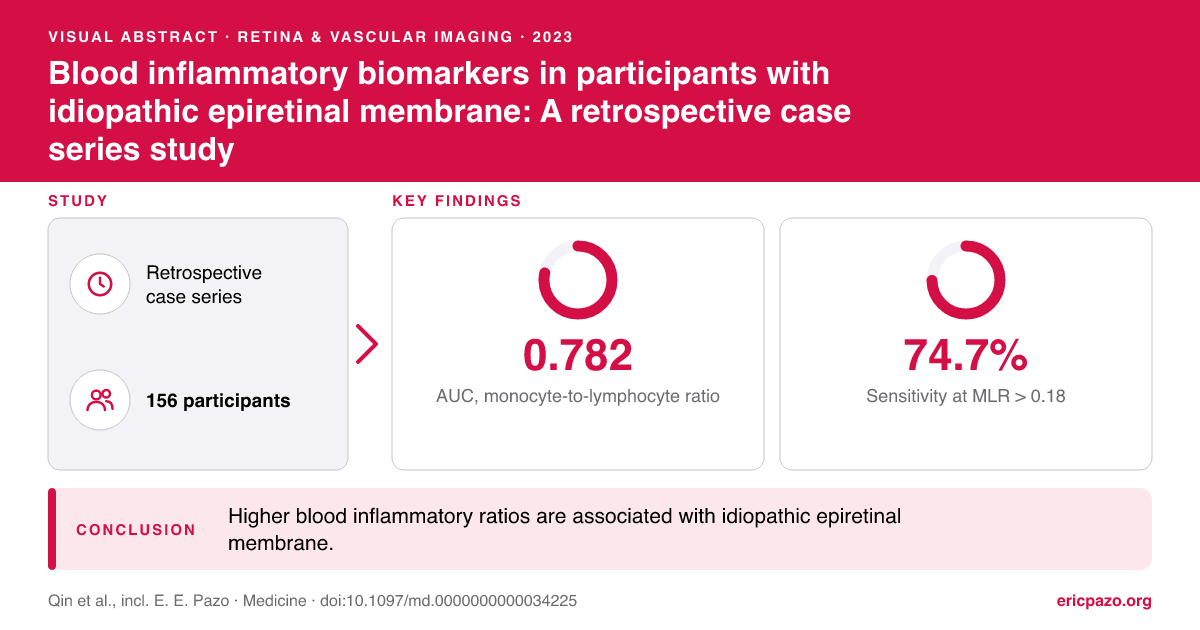
Los cocientes inflamatorios sanguíneos más altos se asocian a la membrana epirretiniana idiopática.
- Diseño
- Serie de casos retrospectiva
- Muestra
- 156 participantes
- AUC, cociente monocitos/linfocitos
- 0.782
- Sensibilidad con MLR > 0.18
- 74.7%
Resumen
El objetivo fue evaluar los niveles del cociente monocitos/linfocitos (MLR), del cociente neutrófilos/linfocitos (NLR) y del cociente plaquetas/linfocitos (PLR) en pacientes con membrana epirretiniana idiopática (iERM). Este estudio retrospectivo de serie de casos incluyó participantes con iERM y participantes con catarata. Se compararon entre los grupos los valores de MLR, NLR y PLR en la sangre periférica de los participantes. El mejor punto de corte de MLR, NLR y PLR en la iERM se obtuvo mediante un análisis de curvas características operativas del receptor, determinando el punto de corte óptimo de cada variable. En total, se incluyeron 95 participantes con iERM en el grupo de estudio y 61 participantes con catarata senil como controles. El recuento de linfocitos del grupo iERM fue significativamente menor que el del grupo control (1.69 ± 0.63 frente a 1.95 ± 0.53, P = .003). El recuento de monocitos del grupo iERM fue significativamente mayor que el del grupo control (0.39 ± 0.11 frente a 0.31 ± 0.10, P < .001). Según la curva característica operativa del receptor, el área bajo la curva de MLR, NLR y PLR para diferenciar a los pacientes con iERM de los controles fue de 0.782, 0.645 y 0.657, respectivamente. El mejor punto de corte de MLR fue > 0.18, con una sensibilidad y una especificidad del 74.7% y el 75.4%, respectivamente. El de NLR fue > 2.06, con una sensibilidad y una especificidad del 50.5% y el 83.6%, respectivamente. El de PLR fue > 95.89, con una sensibilidad y una especificidad del 86.3% y el 41.0%, respectivamente. Los resultados de este estudio sugieren que la inflamación sistémica puede estar asociada a la iERM. Los pacientes con iERM pueden tender a presentar valores altos de MLR, NLR y PLR.
Traducido del resumen original en inglés (licencia: CC BY).
Mostrar el resumen original
The objective was to evaluate the levels of monocyte-to-lymphocyte ratio (MLR), neutrophil-to-lymphocyte ratio (NLR) and platelet-to-lymphocyte ratio (PLR) in patients with idiopathic epiretinal membrane (iERM). This retrospective case series study comprised of participants with iERM and participants with cataract. The values of MLR, NLR, PLR and from participants' peripheral blood were assessed among groups. The best cutoff value of MLR, NLR, and PLR in iERM was found by performing a receiver operating characteristic curve analysis and determining the optimum cutoff value for each variable. In total, 95 participants with iERM were included in the study group, and 61 participants with senile cataract were included as controls. The lymphocyte count in the iERM group was significantly lower than the control group (1.69 ± 0.63 vs. 1.95 ± 0.53, P = .003). The monocyte count in the iERM group was significantly higher than the control group (0.39 ± 0.11 vs. 0.31 ± 0.10, P < .001). The area under the curve of MLR, NLR, and PLR in differentiating patients with IERM and controls was 0.782, 0.645, and 0.657, respectively, according to receiver operating characteristic. The best cutoff value of MLR was > 0.18, with sensitivity and specificity of 74.7% and 75.4%, respectively. The NLR was > 2.06, with a sensitivity and specificity of 50.5% and 83.6%, respectively. The PLR was > 95.89, with a sensitivity and specificity of 86.3% and 41.0%, respectively. The findings of this study suggest that systemic inflammation may be associated with iERM. IERM patients may be prone to have high MLR, NLR, and PLR values.
Palabras clave: idiopathic epiretinal membrane; inflammatory markers; monocyte-to-lymphocyte ratio; neutrophil-to-lymphocyte ratio; platelet-to-lymphocyte ratio; systemic inflammation; senile cataract; lymphocyte count
Acceso
Cómo citar
Mostrar BibTeX
@article{qin2023blood,
  title = {{Blood inflammatory biomarkers in participants with idiopathic epiretinal membrane: A retrospective case series study}},
  author = {Qin, Guanghao and Lin, Tiezhu and You, Yue and Shang, Mingxin and He, Wei and Pazo, Emmanuel Eric},
  journal = {Medicine},
  year = {2023},
  doi = {10.1097/md.0000000000034225},
  url = {https://doi.org/10.1097/md.0000000000034225},
}
Trabajos relacionados
- Biomarcadores inflamatorios sanguíneos en participantes con membranas epirretinianas idiopáticas (título abreviado: biomarcadores sanguíneos de la iERM) (2022)
- Asociación entre la presión de perfusión ocular media y la retinopatía diabética proliferativa en una población del norte de China (2026)
- Asociación de los conocimientos y actitudes sobre el tratamiento anti-VEGF con la interrupción autodeclarada del tratamiento: un estudio de clasificación con separación temporal (2026)
- Medición automatizada basada en aprendizaje profundo del volumen de retinosquisis y desprendimiento en la miopía patológica con contracción escleral posterior (2026)
- Desarrollo de un modelo predictivo basado en datos de citocinas del humor acuoso para la respuesta al tratamiento anti-VEGF en el edema macular diabético (2026)